


INTERVIEW: Elsewhere
[ Exclusive Interview ] ARTIST: Lee Ji Eun
1. This exhibition continues the concepts of rest and healing from your past work. You’ve mentioned that the creative process is also like “slowly building your own home and garden.” If you were to build a utopia of your own, what kind of place would it be?
Lee Ji Eun: The scenery I’ve been painting is probably that utopia. Just as things change as we go on living, I believe the utopia I imagine or dream of will keep changing too. For now, my utopia is probably the landscapes that appear in my paintings.
2. We live in an era full of information and stimulation, yet your work often presents a slow and quiet sense of time. Is this something you deliberately maintain in your creative process? Is the environment you work in also equally quiet?
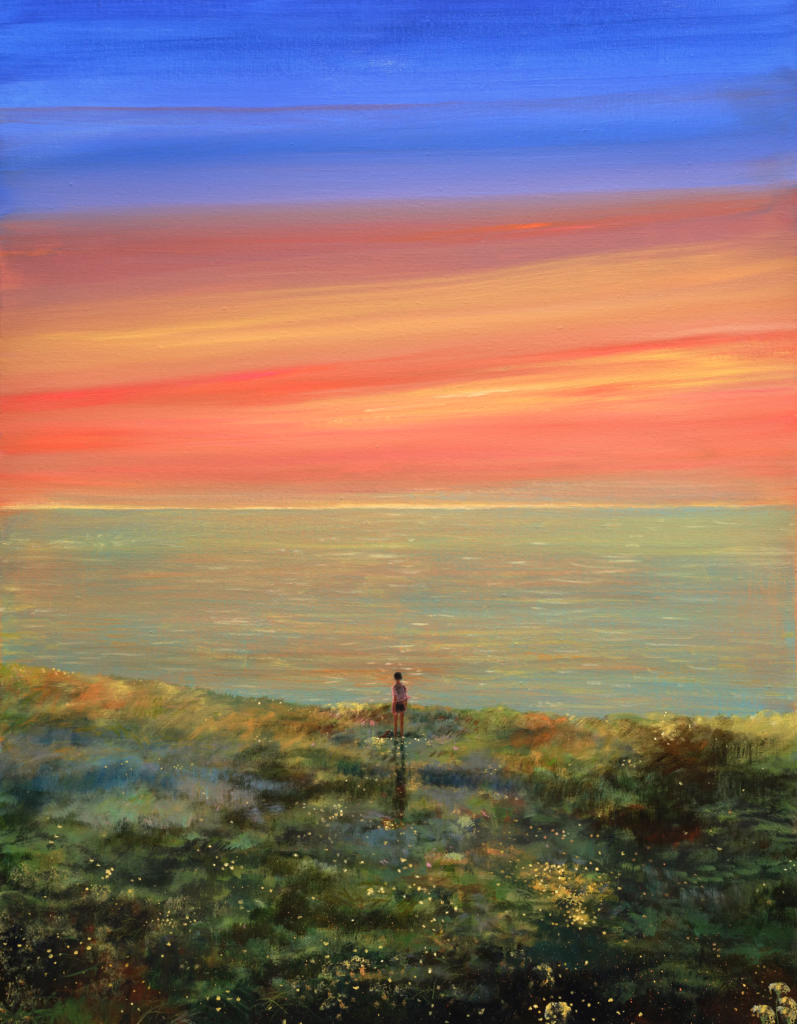
Lee Ji Eun: It’s less something deliberate and more that my nature itself favors quiet and stillness. I think I instinctively seek out the quiet of nature — the sound of the forest, the sound of waves at the sea. It seems to come out unconsciously. My studio is quiet as well.
3. You once said: “Whenever life becomes difficult, or when I feel exhausted inside, I always find myself picking up a pen to draw without realizing it.” Could you share when you first discovered that drawing could help you process your emotions? Are there other ways besides drawing?
Lee Ji Eun: There were times when I was drawing and, for no reason, tears would fall. And after finishing a piece, I’d realize time had passed quickly without my noticing — that, to me, was a trace of my mind being healed. Being able to focus entirely on the drawing, without any distracting thoughts, felt no different from meditation. As a child, I used to draw comics and express my own stories through doodles, and I think that process, more than writing in a diary, was how I came to understand myself. Besides drawing, I manage my emotions through exercise that makes me sweat, and through sleep.
4. During the creative process, do you usually start with an emotion you want to express and then gradually form the image, or do you first paint a scene and let the emotion gradually emerge through the process of painting?
Lee Ji Eun: An image comes to me first, and as I paint it, I focus on tracing back to the emotion from which that image originally arose, and building the work around that. For example, if I imagine a party or some joyful scene and want to paint a happy gathering of people, I’ll think, there’s this kind of person here, this kind of situation happening, this person is doing this… It feels a bit like playing with dolls as I paint.
5. Your images often appear very calm, but the figures within them frequently seem quite small, as if existing inadvertently within a vast world. What considerations led you to have figures exist at this kind of scale within the frame?
Lee Ji Eun: Part of it is an intention to awaken a sense of the vast presence that nature holds. And in terms of composition, honestly, the composition in my paintings is all “wrong,” in a sense. This unstable composition is also a reflection of my own unstable psychology, and there’s a bit of a rebellious streak in it too — a sense of, why does a composition have to follow the rules so precisely when painting? There might be other compositions that give people a different kind of visual comfort; I’d rather paint more freely. But above all, if you look at ancient Egyptian murals or East Asian paintings, the important figures or elements were always drawn larger. Maybe, deep down, it’s because I truly love nature and landscapes that I paint them so large. And the small figure is myself — I think there’s a wish embedded in it, that this vast something would warmly embrace a lonely, sad, wounded version of me. I think painting an unstable composition, while finding a great sense of peace within it, shows a kind of complicated, layered emotion.
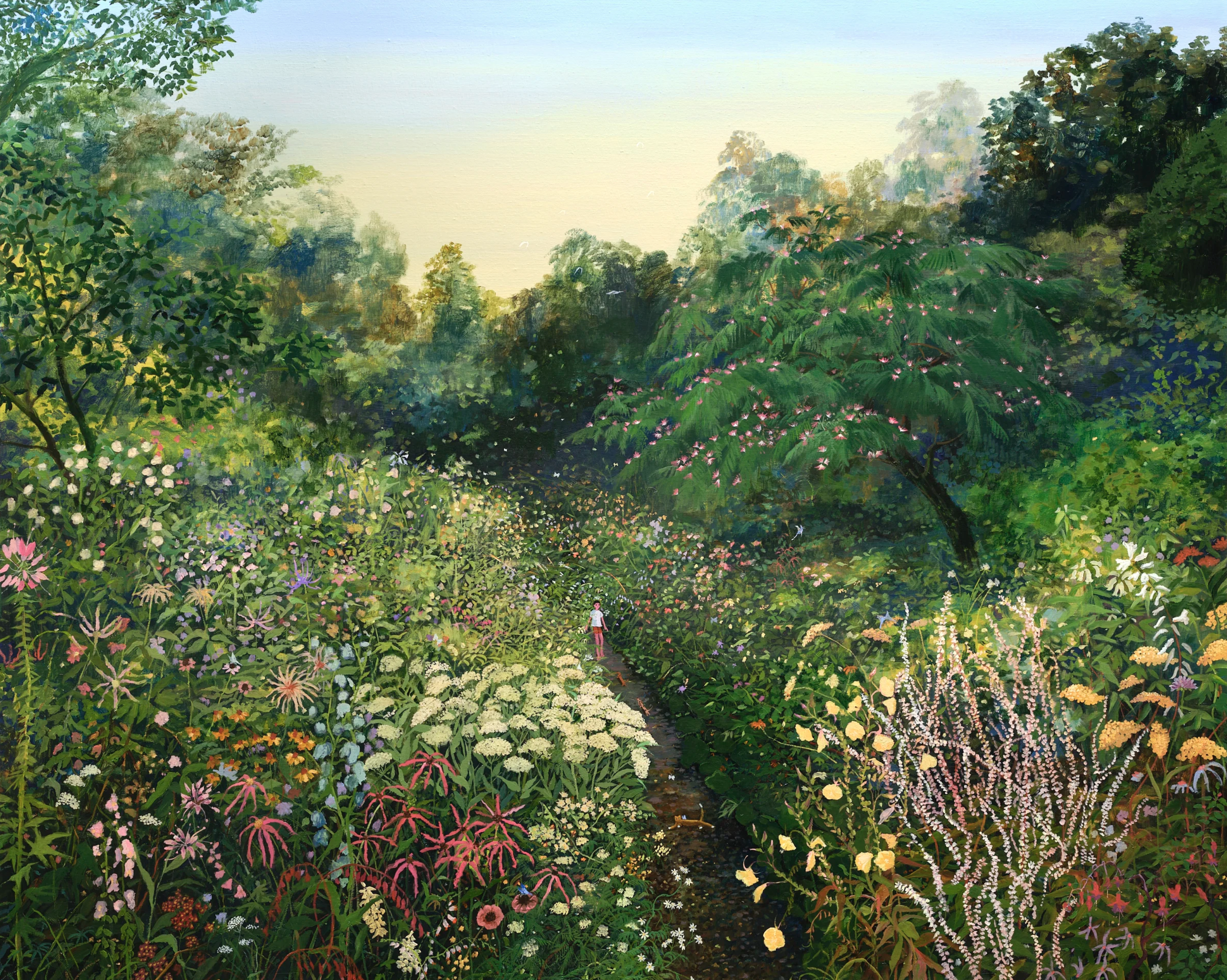
6. The figures in your works are often in a still state, simply floating, watching, or lingering. How do you define “rest”?
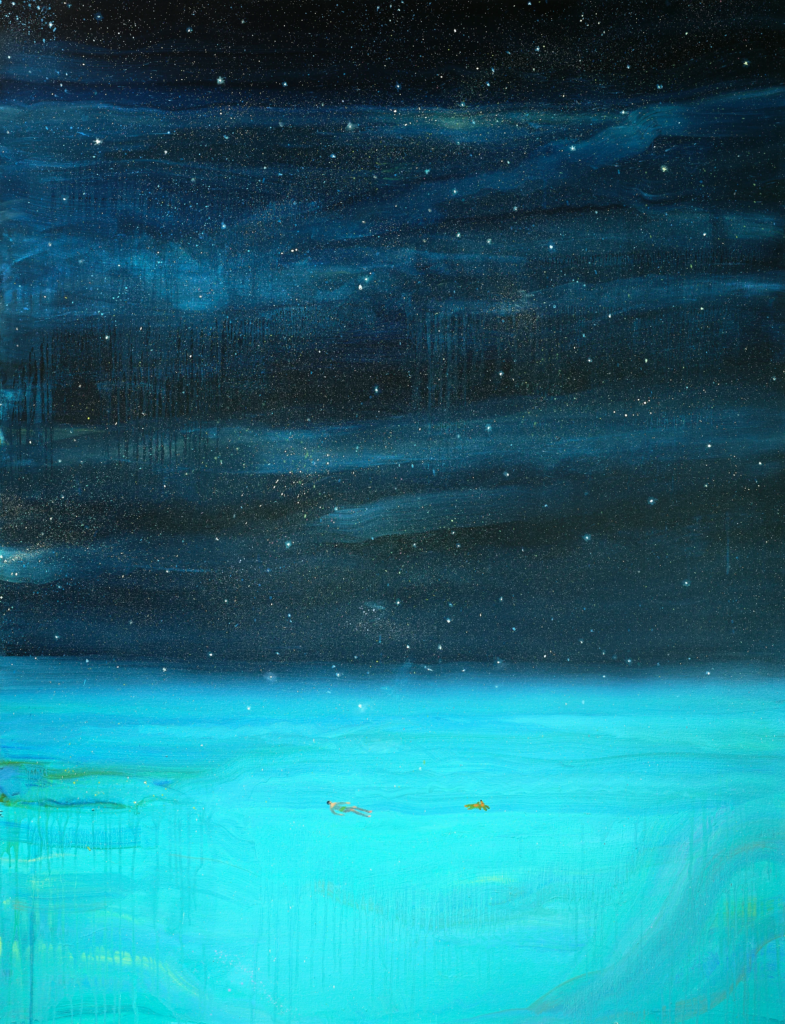
Lee Ji Eun: I like doing nothing and just lying down; I like being in a blank, unfocused state. My body seems to define that as rest. When I’m floating in the sea or submerged in water, all I can hear is my own heartbeat — and it’s in that moment that I truly feel alive. That heartbeat, that part of my own body, is what makes me feel calm and still.
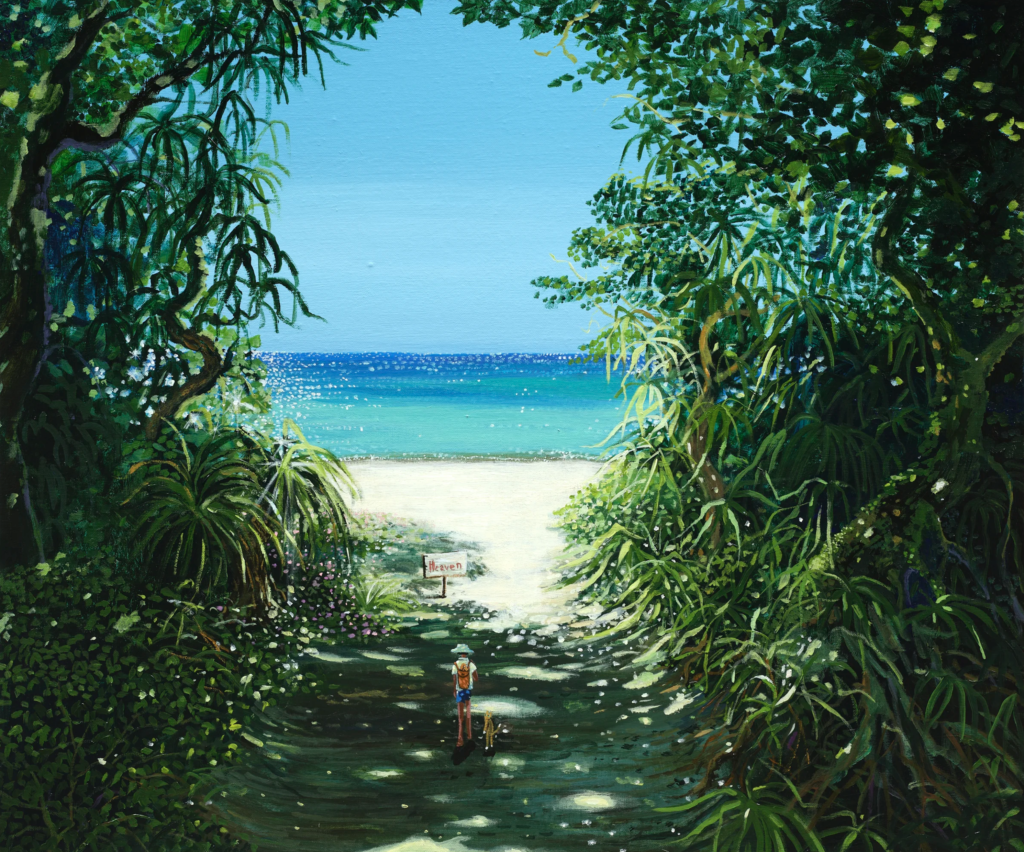
7. In the work “Heaven,” a sign reading “Heaven” appears between the forest and the sea. To you, is this a real destination, or a psychological ideal state?
Lee Ji Eun: It’s both a real destination and a psychological state. I have several different visions of the heaven I dream of, and this is one of those places. That said, it’s not entirely fictional — it’s a place I want to visit, rendered a little more beautifully, and I call it “heaven.” I painted the setting in “Heaven” while imagining Okinawa, Japan. I still haven’t actually been there (laughs).
8. Water appears frequently in your work: swimming, floating, paddling, and scenes of figures immersed in water. What special meaning does water hold for you?
Lee Ji Eun: Water is truly special to me. I’ve lived by the sea since childhood, swimming and fishing there. I also often went to mountain streams, and the clear water flowing between the rocks always felt like it was washing away any dirt in my mind — visually and audibly both. And the deep, clear turquoise sea I’ve encountered while traveling is truly beautiful. The warm, lukewarm temperature of the water also reminded me of amniotic fluid. When I dive deep, all I can hear is my own heartbeat, and in that moment I wonder — is this what it felt like inside my mother’s womb? I painted a series carrying this meaning called Grand Bleu — paintings of a deep blue sea where only a person and a dog swim together. I still find myself returning to paint that series about once a year. Water is an element I simply can’t do without, just as the human body itself is made up mostly of water.
9. In some works, the figures are sometimes accompanied by a dog or a cat. Does this quiet companionship represent, for you, a form of companionship different from that between people?
Lee Ji Eun: Pets, to me, symbolize love — not just an animal’s love, but a love that stands in for human love, for all love. I use them as a medium through which to depict and express that. They represent the love and the refuge found within every human relationship.
10. Some works place figures, natural scenery, and indoor spaces together. What made you want to bring “home” and “nature” together?
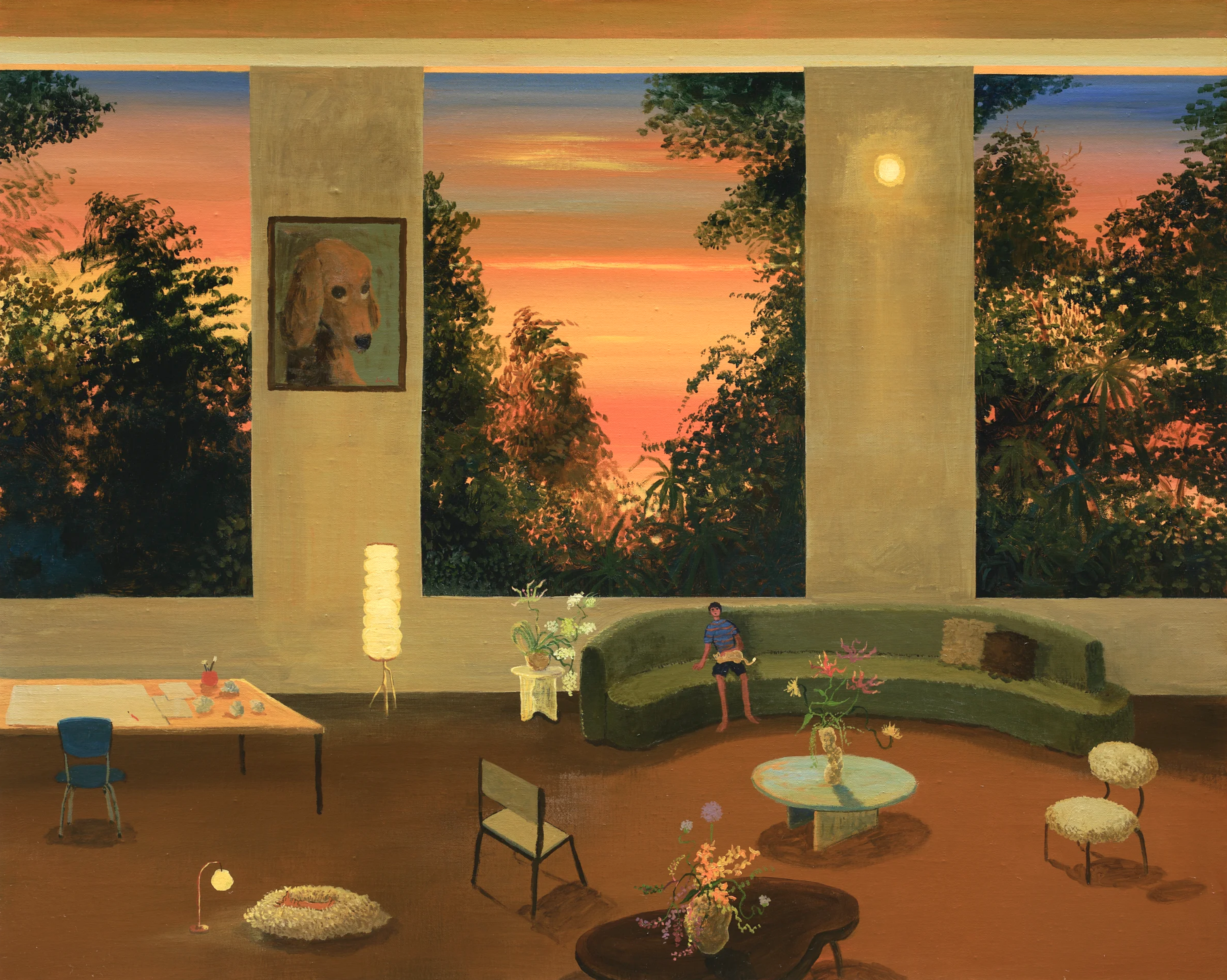
Lee Ji Eun: Because my childhood was always marked by a sense of insecurity, I needed a stable space of my own — somewhere I could hide, a safe place free of worry, something I always longed for. I think I imagine and paint my future home every day: I’ll have a garden like this, arrange the furniture in this kind of layout, place this sofa facing the garden, and so on. As I mentioned earlier, it feels like a kind of simulation, like playing with dolls, that ends up healing my emotions — comforting me, and holding a quiet hope that one day I’ll truly have a home of my own. I also believe nature and human beings exist in coexistence, always present together. The home is my stable space, and the garden, nature, and animals in front of it are the things I love, staying within my space — almost like a castle wall that protects and hides me.
11. In your indoor scene works, various designer furniture pieces often appear. Why did you want to depict furniture? Do you have any furniture you particularly like?
I’ve always liked clean, simple lines. As I naturally studied art, I also came into contact with design, and I think design’s roots grew out of art itself — design is another artistic form that has developed alongside human technological progress and convenience. I still don’t know a great deal about design; I mostly remember shapes and images rather than designers’ names or the names of brand chairs. Even so, I think they created truly abstract and beautiful new lines out of the human body — a wonderful, three-dimensional kind of abstraction. By placing that into my paintings, I feel like I’m creating another layer of abstraction. I’m often inspired by and reference that furniture to draw pieces of my own, subtly altering existing designs as I go.
The furniture I particularly love is Hans Wegner’s GE259 daybed.
Another reason I paint furniture into my work might simply be desire — since I can’t own the things I want, I paint them and make them mine that way, with a quiet hope that one day I’ll actually own such pieces.
12. Your work is filled with all kinds of different outdoor destinations, which feels inspired by travel. Where would you most want to go in Taiwan?
Lee Ji Eun: Yilan, in Taiwan. I’ve heard it’s known for its uniquely quiet nature and clear water. I’d also love to visit Shilang Diving Area — I’ve heard the coral in its clear waters is beautiful, and I’d really like to try freediving there.