


INTERVIEW: You and Me and Everyone We Have Met
[ Exclusive Interview ] ARTIST: Sareena Sattapon
1. Having started with a background in painting, your practice evolved into complex video installations during your doctoral studies in Japan. You’ve noted before that a single canvas can feel limited in capturing the weight of your themes. What was the turning point for you to embrace moving images? What is it about the medium of video that allows you to express the layers of existence and invisibility in ways that painting cannot?
Sareena: It’s not that painting is insufficient; rather, painting and video installation fundamentally operate with different functions. For me, choosing video installation as a primary medium is not about abandoning painting, but about selecting a tool that more closely aligns with what I want to explore.
Video installation works directly with the viewer’s perception, both visually and sonically. At the same time, this apparent directness can be carefully constructed and transformed into complexity through the elements within the installation itself.
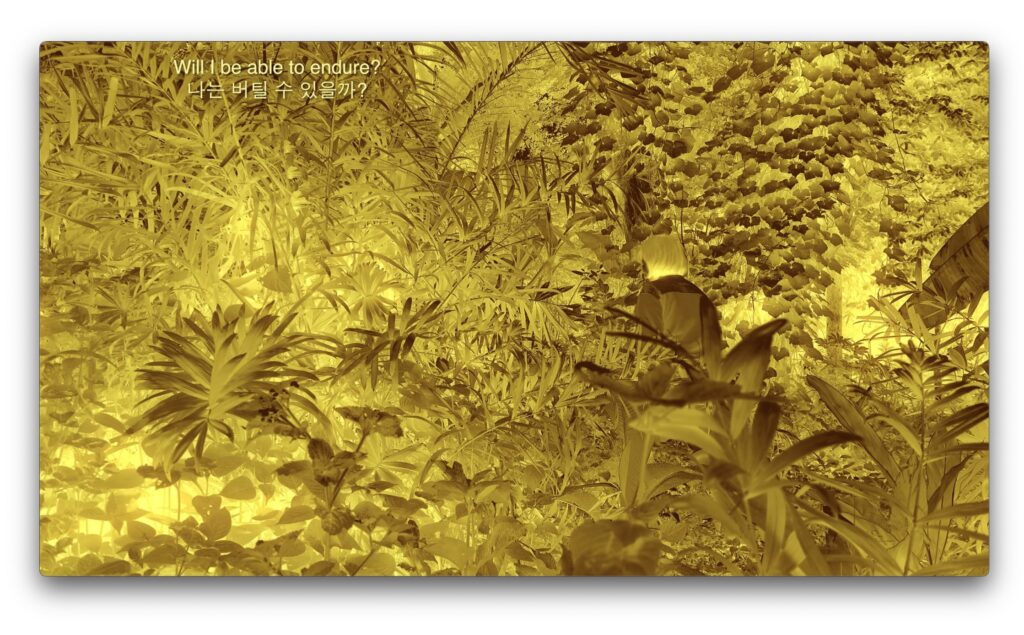
In my work, the video cannot be viewed directly. The only way to access the image is for the viewer to position their body in a way that allows them to perceive its reflection from the monitor. When seen with the naked eye, what appears is only emptiness.
In this sense, video is not merely an image being displayed, but a condition of visibility that depends on the presence of the viewer. Painting, on the other hand, simply “exists” in front of us—it does not demand participation in the same way.
2. I love your idea of treating video as a form of sculpture. You use things like acrylic covers and polarizers to make the screens more than just flat surfaces, encouraging the audience to physically interact with the work to see it. Could you explain how you actually achieve these effects? I think many people would be curious about the ‘how’ and the science behind it!
Sareena: Actually, the mechanism itself is quite simple. I work with materials such as monitors, mirrors, and acrylic sheets, which I modify in specific ways.
Once altered, the monitor emits light at an unusual angle. Because of this shift, the human eye is no longer able to perceive the presence of color in that light, and the screen appears empty.
It is then the role of the mirror and the acrylic surfaces to redirect the light back into a perceivable angle. Through this process, the image becomes visible again—but only under certain conditions.
3. Much of your work focuses on “unseen” laborers. When did you first become truly aware of their presence? Was there a specific person or event that moved you, or was it more of a gradual realization over time?
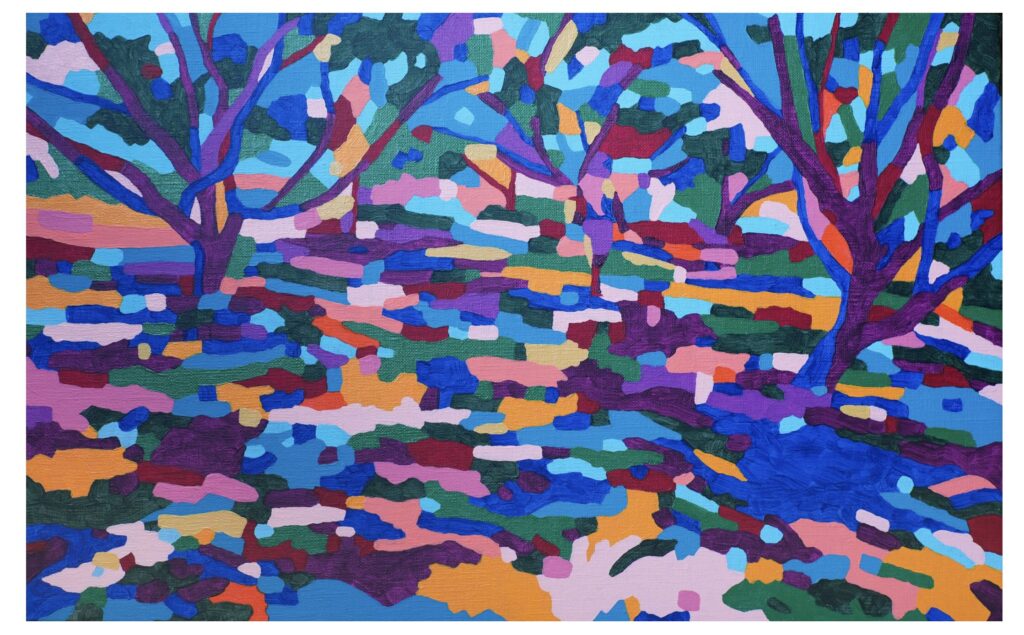
Sareena: I think I began to seriously reflect on this right after I graduated from my master’s degree. It was the first time I worked as a temporary employee at an organization, and in that moment, I became a “laborer” myself.
Through that shift in position, I became aware of the vast number of workers who exist behind what we often perceive as polished surfaces—beautiful art exhibitions, stylish clothing, luxury malls, high-end condominiums, restaurants, and almost everything we can imagine.
It wasn’t a single person or event that triggered this awareness, but rather the experience of situating myself within that structure of labor.
4. You’ve spoken about how your background as a Thai ethnic minority informs your vision. How do you feel this identity flows through your entire body of work? How do your own life experiences connect with those larger questions of labor and belonging in your art?
Sareena: I think my background as a Thai ethnic minority shapes the way I instinctively approach and read social situations. I tend to observe from the perspective of those who exist on the margins—from smaller, less visible groups within society.This way of seeing naturally connects to my interest in labor and belonging. It makes me more attentive to who is included, who is excluded, and whose presence is overlooked or taken for granted. Rather than speaking about these conditions from a distance, my own lived experience allows me to navigate them from within.
5. The title “Balen(ciaga) I belong: All that glitters” is quite unique. You’ve used brackets to break apart the brand name “Balenciaga.” Is there a specific meaning behind this visual treatment?”
Sareena: There isn’t a particularly complex meaning behind it. It started when Balenciaga released a collection inspired by inexpensive Thai bags. I found that situation both interesting and a bit sad at the same time, and it resonated with my ongoing interest in labor and class.
The use of brackets to break apart the name is a way of slightly disrupting the brand itself—treating it not as something fixed or authoritative, but as a reference that can be recontextualized.
6. You’ve been working on the “Balen(ciaga) I belong” series for several years now. From performing with heavy bags to creating videos and paintings, you’ve physically put yourself in the shoes of laborers. How did this journey start? What is it about this theme that makes you want to keep exploring it through such a diverse range of materials?
Sareena: The “Balen(ciaga) I belong” project actually began from something very personal. Around 2018, my life was full of constant movement and travel, which led to a growing sense of not belonging anywhere. I wanted to create work that could express this feeling of displacement.
In 2019, I started to look more closely at the meaning of the bags I was using in the work. I realized that they were strongly associated with working-class communities. At the same time, I myself had begun to become part of the labor force. This shift made the work expand beyond a personal narrative—it became a way to reflect on broader social issues.
Since then, the scale of the work, both in performance and installation, has grown larger. This expansion reflects not only my own experience, but also gestures toward a collective presence—a mass of people whose labor often remains unseen.
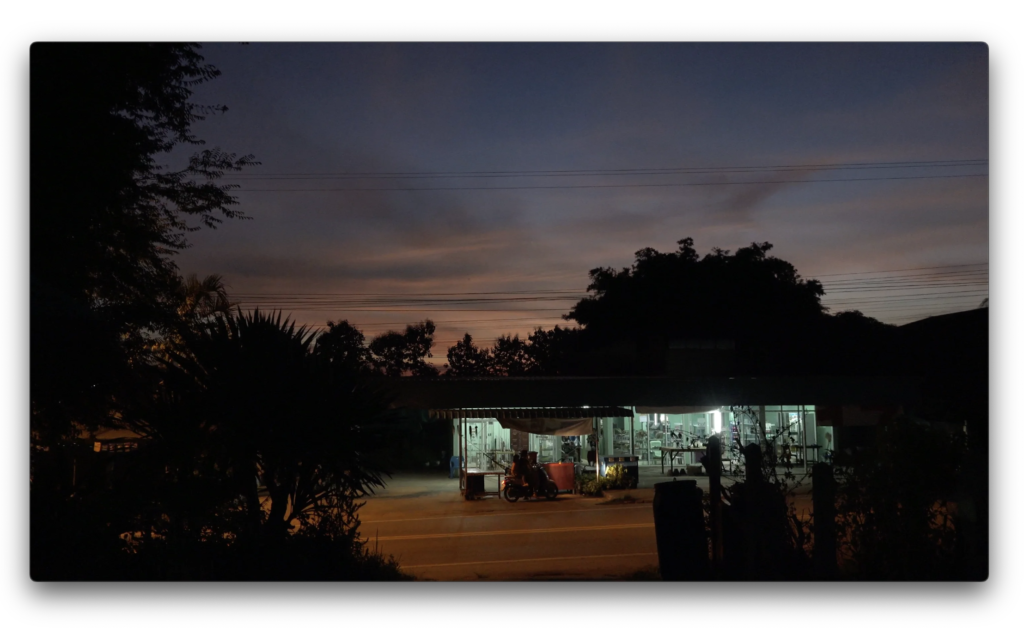
7. In “You and me and everyone we have met,” you capture those fleeting encounters that quietly embed themselves in our lives. To express this “unnoticed presence,” you used layered imagery and temporal disjunction. Could you tell us about your filming and editing process? Why does this fragmented approach better convey your message?
Sareena: “You and me and everyone we have met” is a continuation of “Balen(ciaga) I belong”. While it still engages with the idea of overlooked labor, this project focuses more specifically on migrant workers.
The filming process involved capturing workers across different locations—Tokyo, Bangkok, and Sakon Nakhon, which is my hometown. These places are geographically distant, yet connected through the movement of people and labor. During editing, I intentionally constructed the video through fragmented cuts, layering and shifting between these spaces without a fixed linear timeline.
This fragmented approach reflects the unstable and often disjointed realities of migrant lives—the constant movement, the in-betweenness, and the feeling of existing across multiple places at once. It also mirrors how these presences are perceived in society: partial, interrupted, and often unnoticed.
By avoiding a continuous narrative, the work invites viewers to piece together these moments themselves, much like how we encounter others in real life—briefly, incompletely, yet sometimes leaving a lasting trace.
8. You’ve mentioned that Japanese manga had a profound influence on your early visual development. How did this childhood inspiration shape the way you perceive and approach images today? In what ways do you feel these traces are subtly woven into your current work?
Sareena: I don’t think manga has a direct influence on my work. Rather, it inspired my desire to live in Japan.
And it is this experience of living in Japan that has significantly shaped my artistic approach. It has shifted the way I position myself in relation to my work—while I still tend to observe from the perspective of a minority, I also find myself considering how my work is seen from the viewpoint of the majority.
9. Looking at your journey, you seem to be in a constant state of movement—from Northeast Thailand to Bangkok, Tokyo, Norway, Korea, Osaka, and Taipei. For you, residencies and travel seem to be a mode of creation rather than just a schedule. How has this state of living and observing across different cultures shaped the way you perceive human relationships? And is there anywhere else you’re particularly eager to go next?
Sareena: I think being in different places has allowed me to observe both the similarities and differences in how people form relationships. No matter where we are, there is always a desire to connect, to belong, or to be seen by others. But at the same time, the ways these relationships are expressed—through language, behavior, or social structures—can vary greatly depending on the cultural context.
As for where I would like to go next, I’m particularly interested in New York. I’m curious about how relationships function in a city that is so dense, fast-paced, and diverse. In a place where so many lives overlap, I wonder how people experience presence, distance, and connection—whether it becomes easier to belong, or perhaps even more difficult.
10. Your work spans across performance, video installations, and painting, showing that you don’t limit yourself to a single form. Are there any new fields you’re eager to explore? Could you share with us your future plans or any new challenges you’re looking forward to?
Sareena: To be honest, I enjoy working with all mediums. Very often, my works become a combination of performance and installation—perhaps also because I find it difficult to choose just one.
Recently, I’ve been especially enjoying painting. Even though painting has always existed alongside my installation practice, I haven’t really brought the two together within a single work.
So one of my current directions is to create a piece that integrates painting and installation more directly—allowing them to coexist and interact within the same space. I see this as a new challenge, and also a way to expand how my work can be experienced.