


INTERVIEW: Small Flame
[ Exclusive Interview ] ARTIST: Donghoon Rhee
1. You majored in painting in university, but you once mentioned that you started doing sculpture to think about how to paint. What was the turning point or the exact moment when you felt that the flat canvas could no longer hold what you wanted to explore?
Donghoon: It was simply when I became interested in sculpture. It wasn’t really about the flat canvas reaching its limits or no longer being able to contain what I wanted to explore. Rather, wood sculpture was the medium through which I felt I could continue exploring materials and sustaining my curiosity as a creator.
Painting a vase on canvas is certainly meaningful in itself, but at that time, it felt meaningless to me. However, seeing a vase, carving it in wood, and then looking at that sculpture and returning to painting somehow gave the process a certain meaning for me.
It is difficult to explain exactly what that meaning is, though.
2. Looking at your early work, your focus was primarily on botanical still lifes. However, more dynamic subjects, such as cats and K-pop idols, later began to appear more frequently. This feels like a gradual evolution of your artistic focus from stillness to movement. How did this transition come about? Was there a specific observation or moment in your life that triggered this change?
Donghoon: I wanted to make sculptures of things that were close to me. A vase is a common still-life subject not only for me but for painters in general, and cats were the closest subjects in my life because I was living with them.
Although my first cat sculpture captures movement, it was not originally made with the intention of expressing movement itself. Rather, it began with a simple idea: to depict a cat trying to catch a bird. As a result, the cat’s movement naturally became part of the sculpture.
After sculpting plants and animals, I naturally became interested in sculpting human figures as well. That led me to sculpt K-pop idols, who are among the subjects I find most fascinating to observe in everyday life.
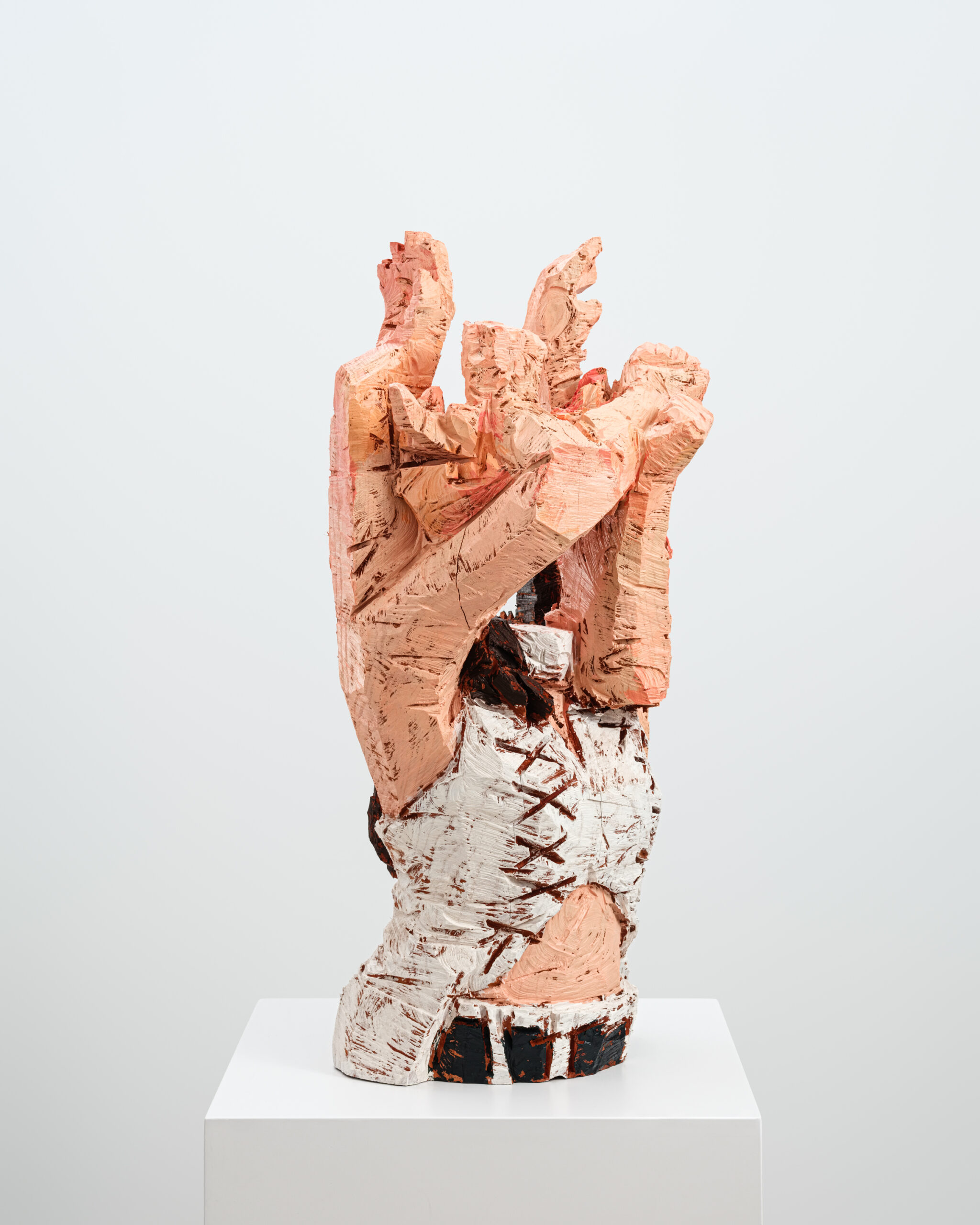
K-pop idols are, in themselves, figures in motion—they are constantly dancing—and at the same time, they have outfits and hairstyles with colors as varied and vibrant as a vase full of flowers. Also, there are countless high-resolution idol fancams on YouTube, which makes them some of the best subjects I could possibly study in detail.
3. Looking at your past work up to this current exhibition, we noticed that you use a very diverse selection of wood—for instance, you used three different types of wood in this exhibition alone. What are your specific considerations when choosing your materials? Also, is there a particular type of wood that you found most challenging to work with during your creative process, and could you share that with us?
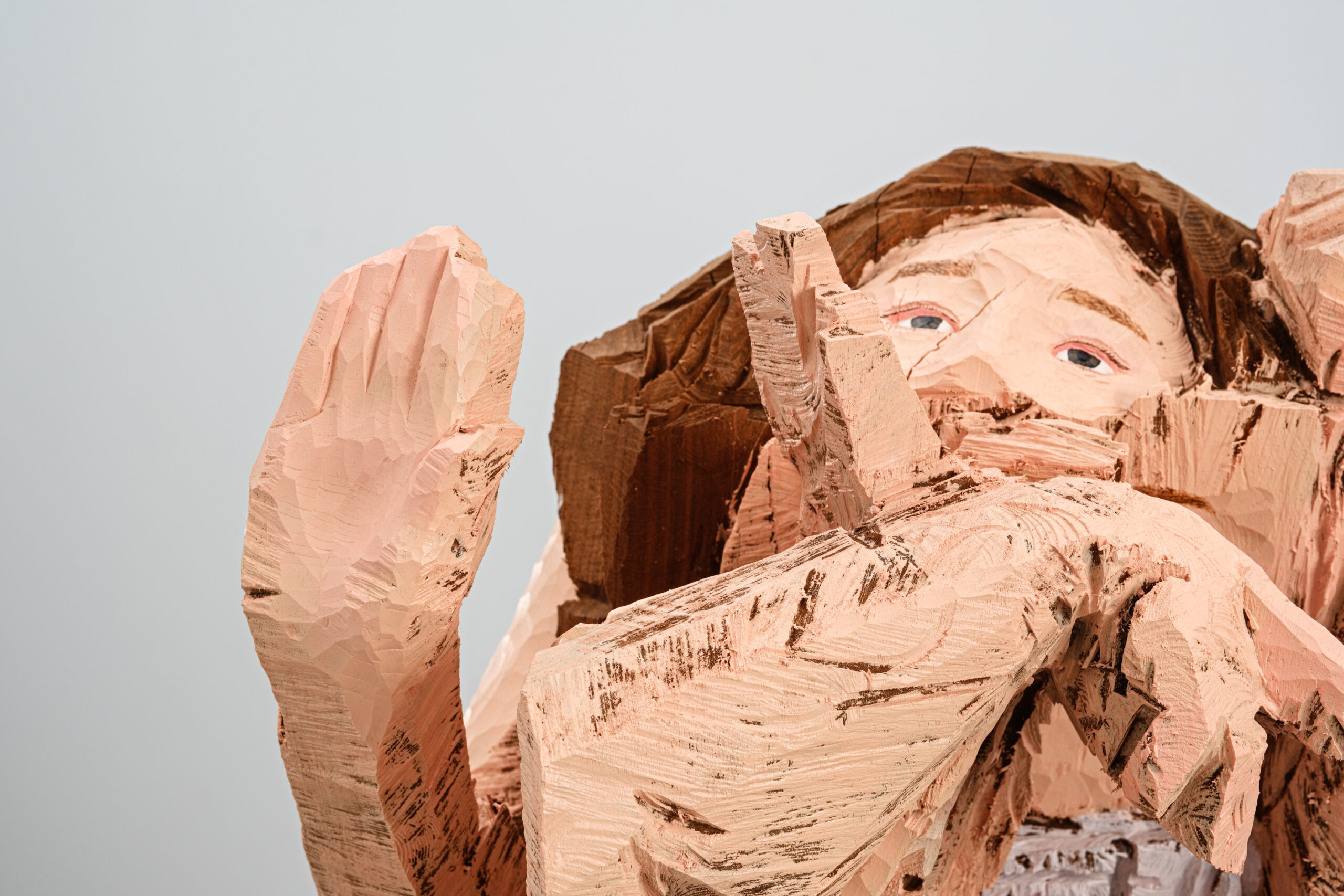
Donghoon: Different types of wood vary greatly in color, hardness, scent, and texture. High-quality wood commonly used for furniture usually belongs to the hardwood category, and similarly, hardwood is often considered a premium material for sculpture as well. But that does not mean softwood is somehow inferior. It simply has different characteristics.
What I find interesting is that wood with different properties can produce quite different results, even when carving similar subjects.
Among all the woods I have worked with so far, elm has been my favorite. It is hard, but not excessively so, which makes it relatively easy to carve, and its distinctive color has a refined, almost antique quality. Since I paint on most of my wooden sculptures, the natural color of the wood also has a significant effect on the paint. Elm works especially well because its color harmonizes with a wide range of pigments.
The most challenging wood for me has been Bakdal birch wood. It is the hardest and heaviest wood I have worked with, and physically, it was extremely demanding. However, the color of Bakdal birch wood and the sense of weight that comes from its density give the material a remarkable presence and strength of its own.
That said, I cannot say I love every kind of wood. Some types of wood, especially those cut in spring while still saturated with moisture, can have a terrible smell. After finishing work and taking the bus home, I often found myself bothered by the smell lingering in my clothes.
4. In your K-pop-themed works, there is a fascinating quality: rather than capturing a single, frozen moment, it feels as if you are condensing a sequence of consecutive movements into a single form, almost like a multi-frame overlay effect. How did you develop this approach? Did it come from repeatedly watching videos or photos, or was there another source of inspiration?
Donghoon: I take screenshots from a selected section of choreography fancam videos, print them out, and observe those images while sculpting.
Sometimes I make drawings first based on the images, but in most cases, I carve directly into the wood and decide on the form intuitively as I work.
5. Observing your previous work, your use of color has always been incredibly vibrant and bold. However, for this exhibition, all the presented paintings are in black-and-white charcoal. What motivated this aesthetic choice?
Donghoon: I think this choice was largely influenced by the types of wood I selected for this exhibition. Walnut and Chinese toon wood both have relatively dark tones, and the colors of TWICE’s outfits, which served as the reference for this exhibition, were also relatively close to monochrome.
At first, I began with oil paintings as I had done before. But at some point, the pencil drawings sitting on my desk looked more compelling to me.
That made me feel that charcoal would be much more suitable for expressing the movement and dynamism of the sculptures. So I changed my original plan and decided to work with charcoal drawings instead.
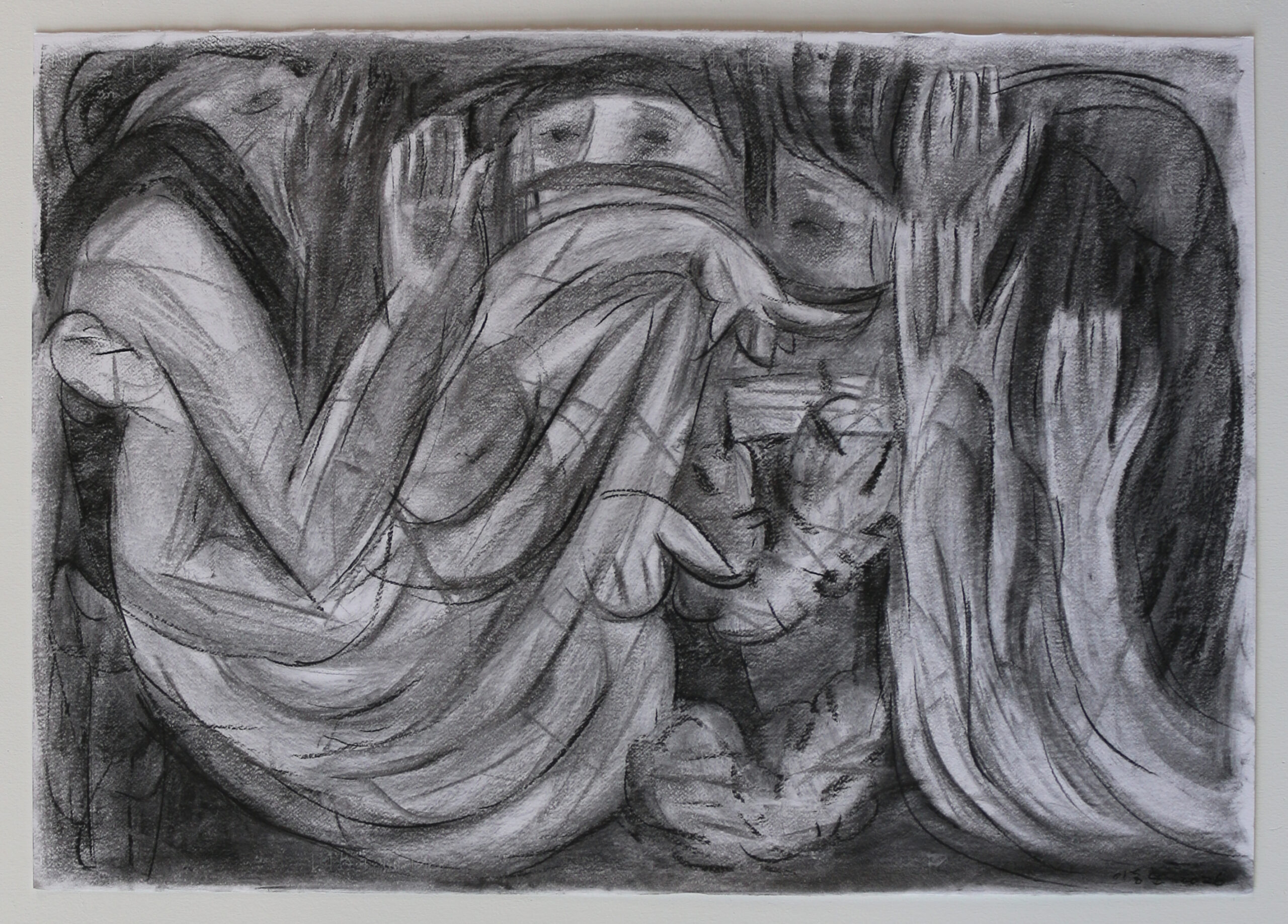
6. This exhibition centers on Tzuyu and TWICE’s very first solo concert in Taiwan. For Taiwanese ONCE, this journey carries an immense emotional weight, considering the past turbulence to Tzuyu finally standing on a stage in Taiwan a decade later. While the Taiwanese media naturally covered this event from a local perspective, we are very curious: what kind of discussions and responses did this milestone spark in South Korea?
Donghoon: In South Korea, I came across quite a few short-form videos and news articles that used this event as an opportunity to revisit the historical relationship between Taiwan and China, especially in connection with the controversy surrounding TWICE.
However, rather than focusing on the controversy from 2016, many fans were deeply moved by the fact that Tzuyu’s long-held dream of performing on a stage in her hometown had finally come true. Seeing Kaohsiung welcoming the concert by lighting the city in blue, many seemed to feel not only pride in TWICE’s achievement, but also a broader sense of pride in K-pop as a whole.
When K-pop first emerged in the 1990s, both its producers and consumers were, for the most part, almost entirely Korean. But over time, more foreign members joined K-pop groups, and eventually groups composed entirely of non-Korean members also began to appear. Seeing K-pop gradually move in a direction where more diverse voices can coexist has been deeply encouraging to me.
What I find especially fascinating is the idea that people can share the weight of a single issue beyond national boundaries, and feel moved together despite coming from different backgrounds. The fact that K-pop can serve as a medium for that is something I find incredibly meaningful.
7. From the exhibition statement, it feels as though the Small Flame’ holds a deeply personal resonance and connection for you. In her letter, Tzuyu mentioned that the small flame ignited in her heart is the hope she has protected since her trainee days, and the strength that kept her going through difficult times. I wonder if you would be willing to share with us—what does this flame represent to you personally?
Donghoon: I think most people carry a “Small Flame” within them, just as Tzuyu does.
For me, it is something like the driving force that allows me to continue living through my work.
Ever since shortly after entering university, I have always been curious about what kind of paintings I am capable of making. That curiosity is what eventually led me to the work I am doing now.
8. In addition to your wood sculptures and paintings, you have also experimented with paper as a medium. Then, the 2025 ‘Long Bird’ series showed a completely different side—using natural, unpainted wood with a very quiet and restrained form, which stands in sharp contrast to the high-energy, vibrant vibe of the ‘K-pop’ series. Since you are always exploring new mediums and styles, are there any particular directions or challenges you are eager to take on in the future?
Donghoon: Wood sculpture is a medium that inevitably involves close communication with the material itself. I have always made wooden sculptures by observing specific subjects such as vases, animals, or human figures, and the material qualities of wood inevitably influence the form, texture, and overall presence of those subjects.
My attempt to express the movement of idols using paper came from a similar line of thinking. I wanted to see how the characteristics of a material could influence my way of expression. Unlike wood, paper immediately made me think about a completely different question: how can this material stand on its own? I think I spent nearly a month thinking only about how to make it stand.
The Long Bird series was created as a way of mourning the death of my pet cat. The sculptures depict birds slowly ascending into the sky, and perhaps because they were shaped through grief and mourning, they naturally took on softer and more gentle curves.
My works usually begin with things that are happening in my life or with subjects I find myself deeply interested in at a particular time. Around the time I was preparing for this exhibition, I had become interested in old Buddhist sculptures from Korea and Japan. Because of that, I think certain qualities of Buddhist sculpture naturally found their way into my work.
In particular, I have been closely looking at the wooden sculptures of Unkei(運慶), a 13th-century Japanese sculptor. His works feel still and quiet, yet at the same time remarkably alive. I do not know whether this interest will directly lead to future works, but I have become interested in creating sculptures that feel vividly alive even without relying on dynamic movement.
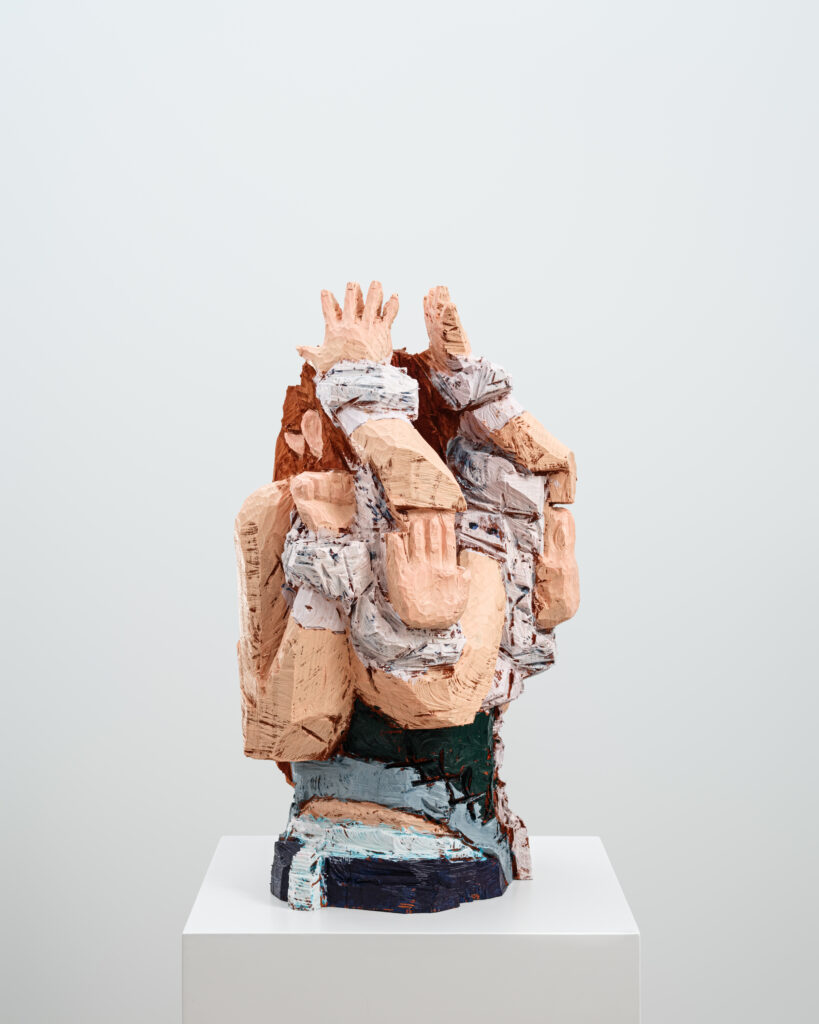
9. I’m curious about your creative environment while working on the K-pop series. Did you listen to their music continuously throughout the process? Does listening to the same group’s songs repeatedly over a long period ever lead to a sense of burnout? Or does it not affect your passion for them at all? Could you describe the overall atmosphere and your state of mind in the studio?
Donghoon: Although I watch a lot of fancams to capture the movement of K-pop idols, I do not listen to music while sculpting. The sound of the chainsaw is so loud that even if I played music, I would barely be able to hear it anyway.
If I become obsessed with a song, I tend to put it on repeat and listen to it until I get tired of it. Eventually, I do feel a sense of burnout, but I tend to think that is simply the fate of popular music. In a way, I think that is part of its charm. When you hear that song again years later, it naturally brings you back to that particular period of your life.
Well, my studio is actually quite bleak. It is rather small and messy, and I am not very good at keeping it organized.
Because of that, when I am in the studio, I tend to focus only on the act of making. Planning the overall direction of a work, or indulging in all the peripheral thoughts and fantasies surrounding it, seems to happen outside the studio.
10. Next, I wanted to slip in a personal question from the perspective of a K-pop fan! Observing your works over the years, your main focus seems to be on girl groups, though SHINee and NCT have also made appearances. I just can’t help but ask: who is your ultimate favorite group? What kind of impact or changes have they brought to your life and artistic practice?
Donghoon:
My bias is NewJeans. Their music, choreography, branding, and the individual abilities of each member—everything about them feels exceptional to me. When I saw NewJeans collaborate with Takashi Murakami, it made me imagine even greater possibilities for how far the K-pop industry can expand.
NewJeans’ music gives me a strong sense of excitement and joy. It feels similar to the emotion I experience when encountering a truly great work of art. I do not think they have brought any dramatic changes to my life or artistic practice, but even so, that feels more than enough.