


INTERVIEW: Fuengfah Factory
[ Exclusive Interview ] ARTIST: Juli Baker And Summer
1. I’d like to start with a slightly mundane question: what is your MBTI? From our conversations and from your work, I can really sense a very straightforward and free-spirited energy. But I’m curious whether, in your private life, you also need a lot of me time to recharge. Is there any difference between who you are in everyday life and who you are when presenting your work?
Juli Baker and Summer: I do not actually know that much about MBTI. I used to be an ENFP, but when I retook the test over the past few years, it came out as INFP. I think I exist somewhere between the two. I can be extroverted in certain situations and feel energized by being around people, especially when they are people I genuinely connect with. At the same time, I really value my alone time and need space to recharge.
Who I am when I present my work is still truly me. Of course, everyone has different layers. That version of me is more professional, where I try to make sense of my thoughts and my work and translate them to the world. My more sentimental and intimate side comes out more naturally through my paintings and writing. Art feels like a safe space for me to express those parts of myself.
2. I completely agree that fashion is an extension of how we express our daily mood and state of mind. Out of curiosity, are there any items you can hardly go a day without? Or is there a particular piece of clothing or accessory that has been with you for a long time and has already become a part of who you are?
Juli Baker and Summer:
Apart from my glasses, which I wear every day, I am almost always wearing jewelry, usually rings or necklaces. Most of these pieces were gifted or made by my mother, my grandmother, or my best friend. They do not just make me feel confident and empowered. They also make me feel loved and remind me of the people who gave or made them for me. Wearing them feels like having those people with me throughout the day.
3. I also transitioned from fashion to art myself, so I’m especially interested in how you see these two fields. I noticed that you still collaborate with the fashion industry, so I wanted to ask whether your creative state or mindset changes when you are working with the fashion industry, compared to when you are creating works for exhibitions. Or for you, are they essentially the same thing?
Juli Baker and Summer: I would say yes and no.
Yes, because I truly believe fashion can also be art. When I collaborate with fashion brands now, they usually give me a lot of creative freedom. I only work with brands whose values I genuinely feel comfortable with, so the process feels very similar to creating paintings for an exhibition.
But also no, because when I work on my own exhibitions, I have complete freedom to shape both the work and the message. I originally shifted away from the fashion world after a major heartbreak, when I learned more deeply about the broken systems behind the industry, including waste and the treatment of workers.
I also realized that I did not find much joy in being part of the fashion production process itself. I am happiest in my small studio, sketching and painting, so being an artist suits my way of life more. That said, I still love beautiful clothes and follow fashion through movements like Fashion Revolution, which I strongly support. I do not see fashion and art as separate worlds, and I enjoy moving between them while supporting efforts to make both industries better.
4. Your work has always been about telling stories of “people” — stories of war and coups, but also of female workers and those small, forgotten individuals. Where do you usually find these impulses and inspirations? Are they drawn from documentaries, books, or certain moments in everyday life?
Juli Baker and Summer: My inspiration comes from all of those places. I believe art reflects how an artist sees and moves through the world. I enjoy observing people and paying attention to small moments in everyday life.
This perspective is deeply connected to my background. I was born into a family that is quite politically active, and I joined protests from a very young age. Growing up in a country with a complex and often unstable political climate has shaped how I think and feel. Politics is not something distant for me. It affects my daily life, the people I love, and even my neighbors. Through my art, I try to tell these stories alongside my own thoughts, hopes, struggles, and what I witness on the streets.
5. From your previous exhibition to this one, I’ve noticed that audiences really appreciate the way you address women’s issues—both gentle and powerful at the same time. Beneath the bright colors, your works also remind people of stories that have been overlooked. The theme of “women” seems to consistently appear in your practice. Could you share more about how you view and approach this subject?
Juli Baker and Summer: It feels very natural to me because I am a woman. This is what I know best. The more I learn about gender and patriarchy, the more resonant it feels and the more inspired I am to make art about it.
I strongly believe that women’s issues and patriarchal structures are not only about women. They affect everyone, including men, in different ways.
6. I like your use of Fuengfah / Bougainvillea as a symbol for the concept of this exhibition. I know that you generally have a strong affection for flowers and plants, but why did you specifically choose bougainvillea? Does it have a particular connection or symbolic meaning for you and for the stories of the female workers?
Juli Baker and Summer: I have bougainvillea at my house, and if you live in Thailand, you will find these flowers everywhere along the streets. They are colorful, bloom easily, and do not require much care. You can almost leave them alone, and they will grow strongly and vividly in their own way.
At the same time, they are not the kind of flowers you usually find in a florist shop. Bougainvillea is often seen as ordinary, yet I find it incredibly beautiful. In Thai, it is called Fuengfah, and the word fah means sky or blue. That poetic meaning made it feel right as a symbol for female blue collar workers who are resilient, overlooked, and powerful.
7. Could you tell us more about the story of the Hara denim factory? What was it about the experiences of the Thai female garment workers that especially moved you? I also noticed the phrase “made by the people, for the people” appears in the works and the exhibition statement. You have consistently used your practice to convey messages. After seeing this exhibition, what kinds of feelings or reflections do you hope viewers will take away?
Juli Baker and Summer: I learned about Hara workers’ movements from a very young age, partly because my father is involved in Thai labour museum, and this movement is one of the most important female workers’ movements in Thailand. However, I only watched the documentary about the Hara Denim Factory last year.
Seeing these young women who had dreams and were brave yet treated so unfairly deeply moved me. It reminded me of myself when I was their age, and I felt connected to them in many ways.
What I hope viewers take away from this exhibition is an awareness of this labor movement in Thailand. I know there is not much I can personally do to change how the fashion industry works, but if people leave the exhibition and later stand in front of their closet putting on their favorite jeans, maybe they will pause and wonder who made these clothes and whether they were free.
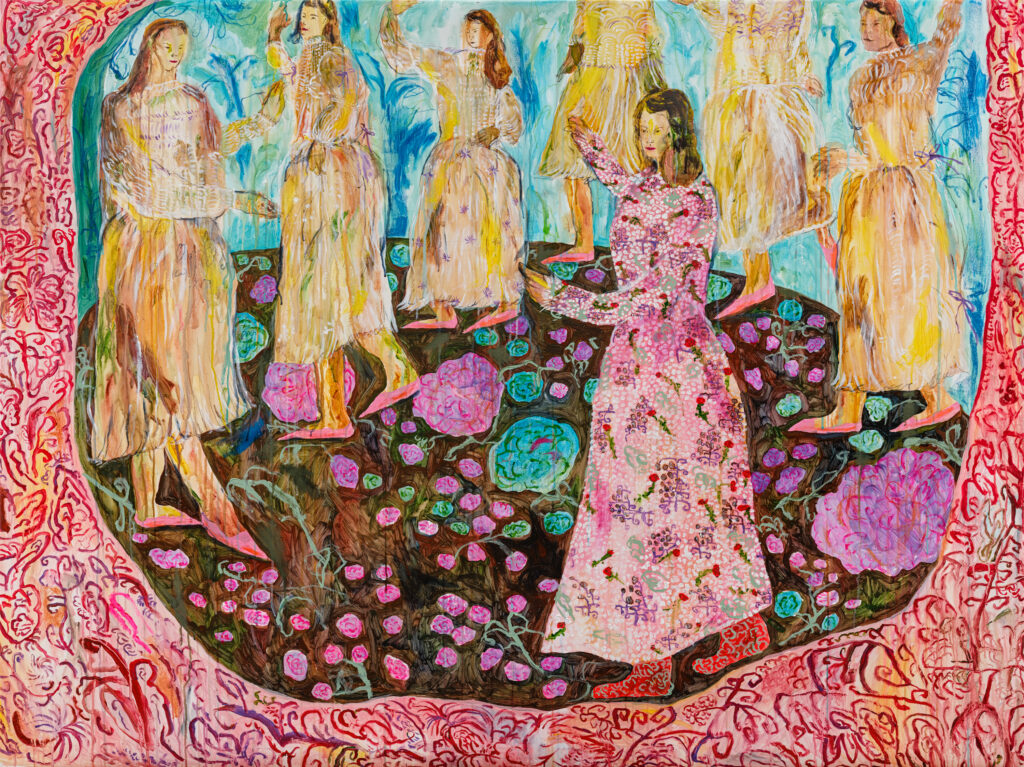
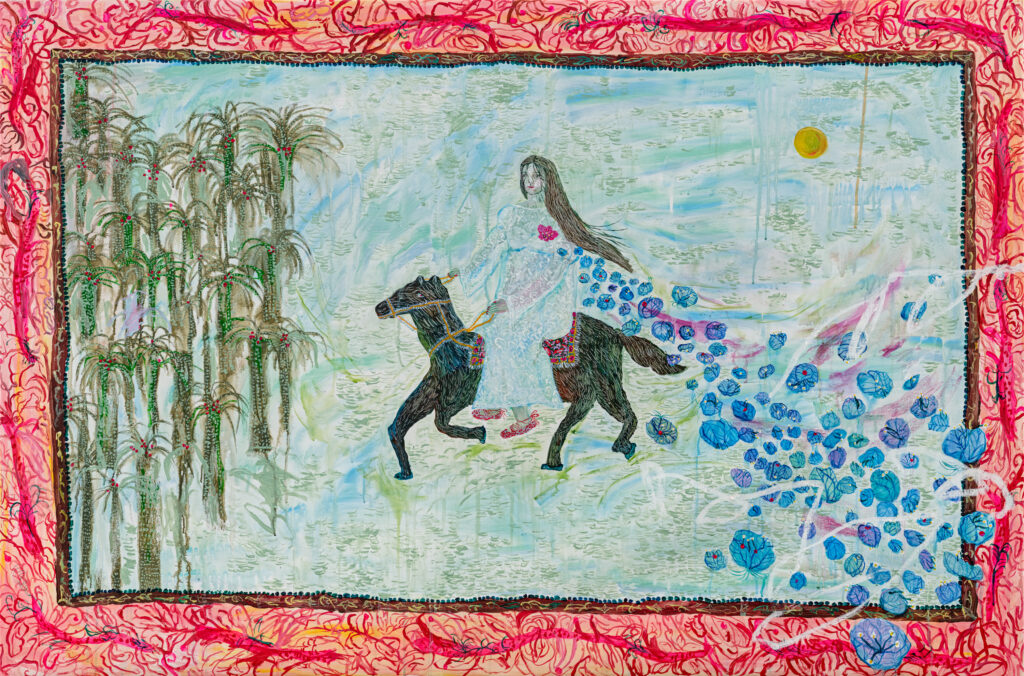
8. Some of the works in this exhibition are quite special, as their presentation resembles tapestries, with decorative borders and the texture of handwoven textiles. Is this an intentional reference to the garment factories and textile themes discussed in the exhibition? Why did you choose to present the works in this particular form?
Juli Baker and Summer: Yes, this was very intentional. I am personally drawn to textiles, tapestry, and craft, and I wanted to bring that texture and sense of uniqueness into the paintings in this exhibition.
I wanted to evoke a feeling of craftsmanship and reflect the idea that a single piece of clothing is woven from the emotions, dreams, and hopes of many people.
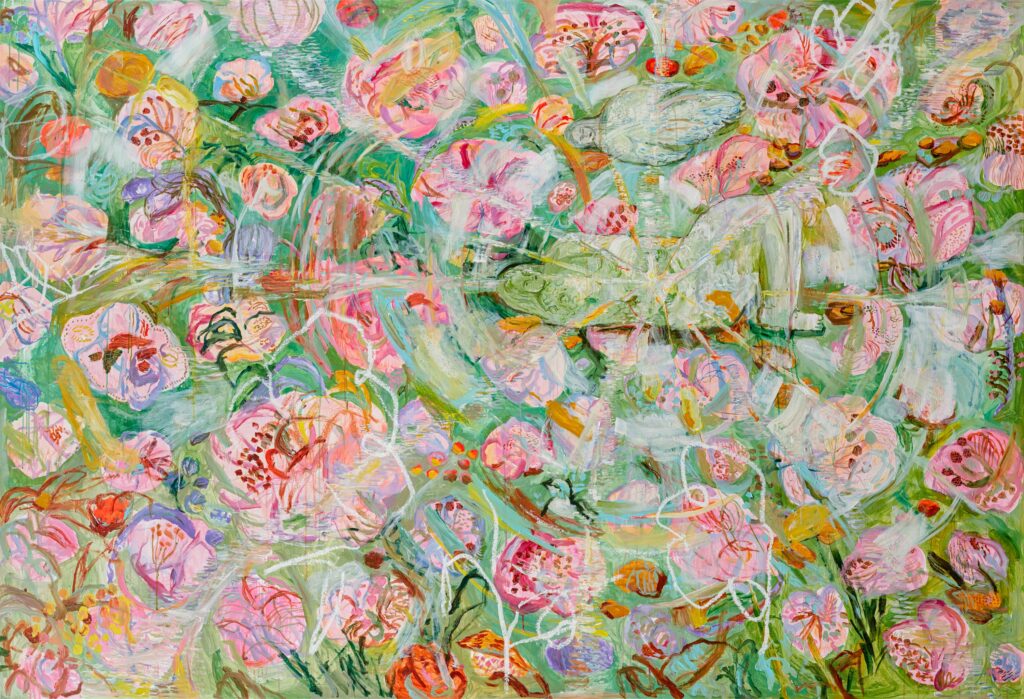
9. From canvas to ceramics, lanterns, textiles, and even cars and glass, it seems like you’re constantly experimenting with different forms of creation—as if the whole world could be your canvas. Among these experiences with different media, was there any that felt particularly challenging? Or is there anything you’re especially interested in trying next?
Juli Baker and Summer: Every medium feels challenging to me, but that challenge is also what makes it fun. I enjoy not limiting my practice to a single medium.
I am interested in bringing art into people’s everyday lives. I want my work to be accessible and not exist only inside a white cube gallery. As long as the work can reach people in different ways and places, I am open to it.
Next, I would love to explore collaborations with music or sound and work more closely with people in the music scene.
10. I’ve noticed that you’re constantly traveling and participating in different residency programs, living in various countries, and absorbing different cultures. These experiences and observations often seem to become nourishment for your creative practice. Is there any place on your “dream list”? What qualities of that place attract you?
Juli Baker and Summer: Yes, absolutely. I would love to visit South America, India, and also spend more time in small towns within my own country.
I do not need much to feel drawn to a place. Good food and kind people are usually enough.