


INTERVIEW: No Man’s Land
[ Exclusive Interview ] ARTIST: Bram Kinsbergen/ Brian Chen/ Su Wong-Shen
Bram Kinsbergen
1. Your scenes feel calm at first glance but carry tension underneath. How do you approach balancing serenity and threat in your compositions? Do you see this tension more as a reflection of environmental crises, internal psychological states, or a dialogue between the two?
Bram: I believe that through the subjects I choose to work with, I inevitably introduce(almost unconsciously)a sense of precariousness. It is a fragile atmosphere suspended between a future that feels finite and a past that, in retrospect, appears almost carefree.
It seems to me that we are living at a societal tipping point, a moment that compels us to reconsider how we, as a community of people, will continue to shape and sustain our shared world. Questions that once lingered in the background now move steadily to the foreground: how will power be distributed, what form will our economic structures take, and (perhaps most urgently)are the systems we rely on truly sustainable?
All of this unfolds alongside the undeniable reality that, in recent decades, we have made quite a mess of things. The climate bears the marks of it. The earth is warming, forests are disappearing, entire biotopes are vanishing, sea levels are rising—each of these phenomena carrying a weight and urgency of its own. When such elements surface in a painting, whether intentionally or not, the viewer’s mind instinctively nudges them toward interpretation, toward a particular emotional and conceptual direction.
For that reason, I try in each of my works to evoke this dual sensation: that suspended, wavering moment where uncertainty and awareness coexist—the fragile point where the past, the present, and the possible future briefly balance before the scales inevitably tip.
2. When you start a painting, do you begin with a memory, an imagined scene, or a real landscape? How does your starting point influence the atmosphere, narrative, and emotional resonance of the final work? Does the process itself carry a personal or philosophical meaning for you?
Bram: I rarely begin a painting from absolute zero. My obsession with painting is considerable; I work constantly, simply because I love the practice itself. As a result, there are almost never truly blank canvases left in my studio.
More often than not, I use white canvases as testing grounds: to try things out, to lay down underlayers, sometimes to sketch the faint suggestion of a landscape, never too concretely. In this way, the confrontation with the intimidating emptiness of a pristine canvas is avoided. The surface already carries a certain history, however modest.
When I eventually begin a new work, I usually have already produced preliminary studies on paper or on smaller formats. These studies give the image a certain initial structure. Yet because I start from a canvas that already bears traces of paint, the final result inevitably diverges from the preparatory work. The painting finds its own path. In this way I try to arrive at an image as spontaneously as possible.
Before that moment arrives, however, a long period of gathering takes place. For weeks, sometimes months, I collect images, fragments that in one way or another relate to the narrative or the series I intend to paint. By the time I begin working, these images exist both in my mind and in my archive. They form a reservoir from which I can draw, allowing me to navigate simultaneously through memory and through a personal visual database in order to construct the final compositions.
3. Water, drifting objects, and empty spaces often interact in your work. Do you see your paintings as a way to map a psychological landscape, a real environmental warning, or both? How do technical choices like composition, color, or texture help you convey these layers of meaning?
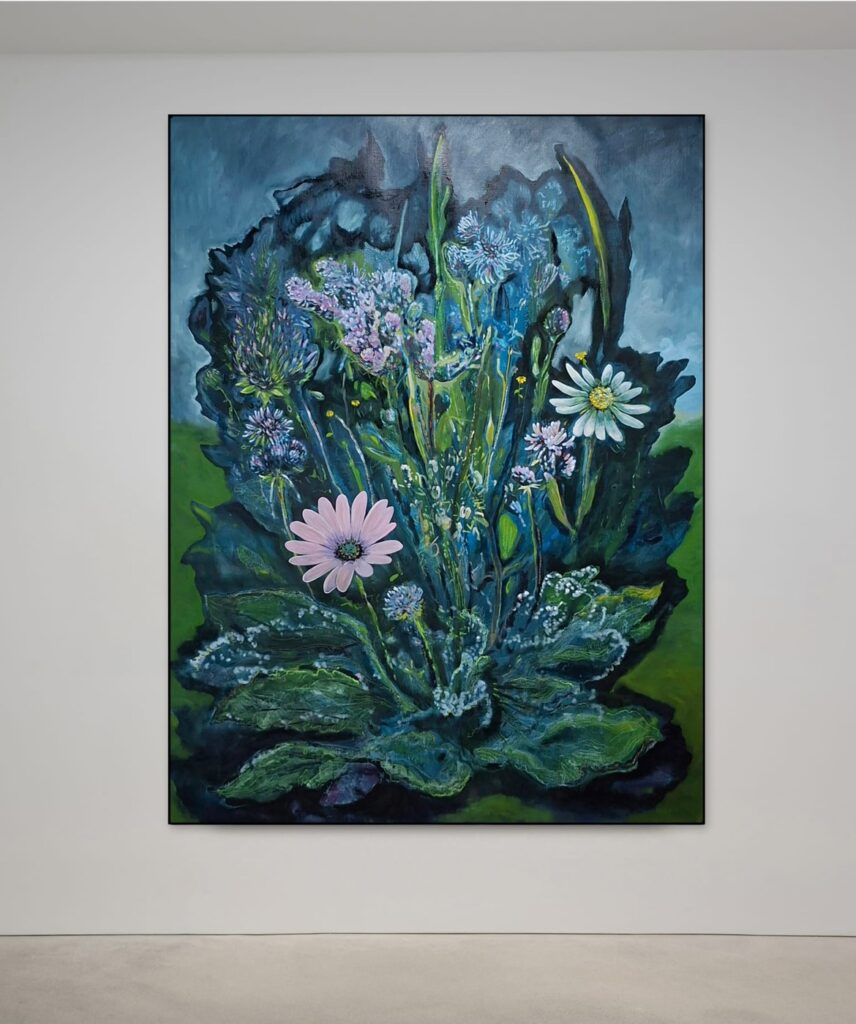
Bram: As you can see, most of my paintings take place in a dark environment. This atmosphere initially emerged from the circumstances in which I worked for a long time: I often painted at night. Over time, however, this setting evolved into something more symbolic, reflecting the solitary position the individual seems to occupy in contemporary society.
The darkness suggests a claustrophobic, enclosed, and sharply bounded space—uncertain, partially invisible. It becomes a metaphor for the ego, for the isolated “I” within our social structures. Within such a space, the individual appears both present and cut off, surrounded by an environment that offers little sense of collective belonging.
For that reason, I often paint only a single figure, or sometimes no figure at all. The absence of people becomes a reflection of the loneliness many individuals experience today. In a society that claims to revolve around social communication, we increasingly find ourselves living in isolation, each of us positioned behind a screen. The paintings attempt to capture that paradox: a world that appears connected, yet in many ways has never felt more solitary.
4. Looking at your titles and the subtle humor you sometimes use, how do words interact with images in your work? Do they guide interpretation, offer contrast, or create a separate narrative layer?
Bram: Indeed, the titles I choose for my works often play a deliberate role in how the painting is approached. Sometimes they provide a clue, a subtle hint that points the viewer in a certain direction. At other times, however, they may do the opposite: they place the viewer on the wrong track, gently misleading them so that the image is interpreted in an unexpected way.
This tension between image and title is intentional. A title can shift the meaning of a painting, allowing a heavy or complex subject to be perceived differently—sometimes even more lightly, sometimes more ambiguously. In this way, the title becomes part of the work itself, not merely a label but another layer through which the viewer navigates the image.
By creating this small displacement between what is seen and what is suggested through language, the painting remains open. The viewer is invited to question their first interpretation and to reconsider the work from another perspective.
Brian Chen
1. In an era where images can be generated and replicated by AI, your works are created through sewing and gradual accumulation. How do you view this kind of handmade labor and sense of time? How does it affect the meaning or message your work conveys?
Brian: The productivity revolution brought by AI is indeed significant. In the future, many things may be rapidly and massively reproduced through code and data, yet it is difficult to fully grasp their authenticity. In contrast, non-commercial, handcrafted work—with its delicate yet rough, imperfect qualities—can perhaps convey a stronger sense of truth.
Just as each person faces a future where traditional labor is about to be disrupted, this moment allows us to reflect on the differences between the self and the collective, and how one can express an authentic self. Compared to computational power and physical AI, humans are defined by the unquantifiable imperfections. In that sense, the shortcomings of our era may become the advantages of a new one.
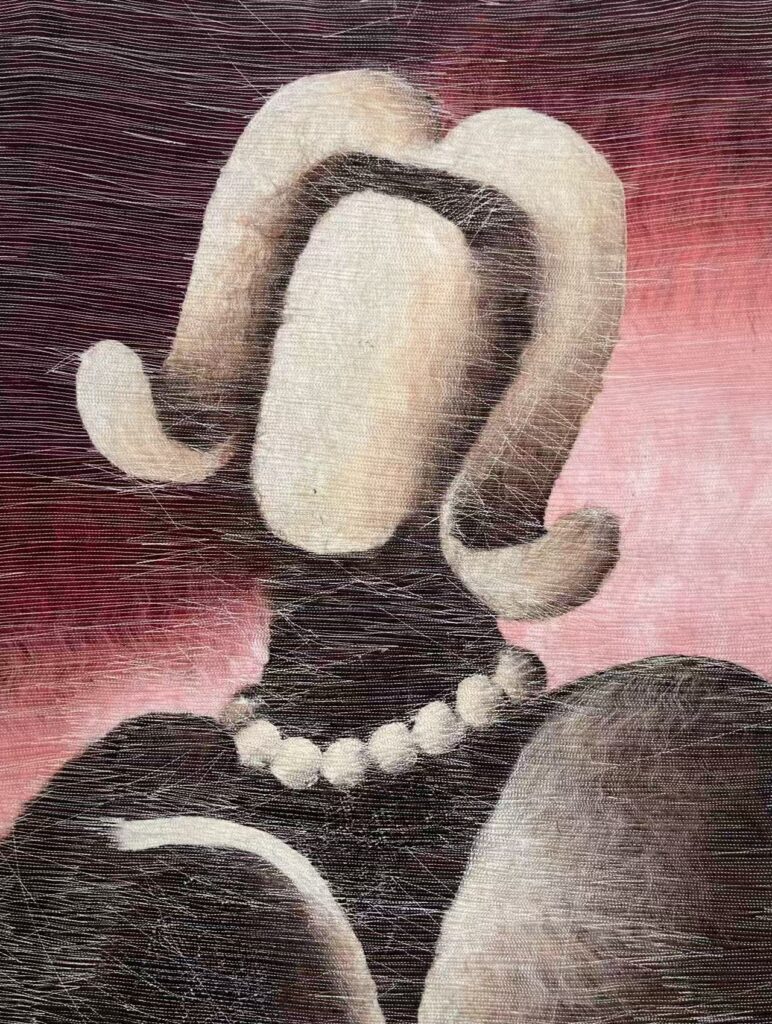
2. Compared to your previous works, this series seems more direct, composed of three characters. Could you share how these characters were conceived? Are they concrete figures, or representations of an abstract state? During creation, do you lean more toward weaving a “story” or expressing “the character’s state”?
Brian: Yes, in this series, each work depicts a single portrait. The concept reflects an imagination of the AI era: when humans are no longer required to be countless “cogs” in companies, each person has the opportunity to explore their selfhood. Questions like Who am I? What are my birth parameters? What is my goal? become more significant.
We are fortunate to witness the world transitioning from analog to digital, and from digital to artificial intelligence. As material wealth and life experiences increase, so too does the explosion of noise and information. How can one filter out unnecessary noise to see the simplest and most powerful version of the self? Everyone’s answer will be different. The blank spaces on the face are precisely for the viewer’s reflection.
3. Given your background in costume design, do you usually have specific concepts for your characters’ clothing? In a previous interview, you mentioned a personal interest in history—was this reflected in the costumes for this series? Does constructing portraits through textile materials make “identity” feel like something woven together?
Brian: Creating portraits by stacking countless fibers and connecting them with a sewing machine holds a meaning for me similar to human growth: our personalities and values are images woven from countless memories and experiences. To me, clothing is an extension of the inner self, like a second layer of skin. Everyone can find what truly fits them, but wearing something unsuitable is like equipping a game character with the wrong gear—it may even weaken one’s strengths.
So how do we know what suits us? That question brings us back to understanding the self. If the human world were a virtual game, then understanding your own abilities and special traits first seems quite interesting. I also look forward to sharing the experience with future viewers and hearing their thoughts on the works.
Su Wong-Shen
1. In previous interviews, you mentioned that many recurring symbols appear in your works—such as streetlights, stairs, and balloons—and that they are influenced by the metaphorical language of traditional Chinese opera. Beyond these familiar symbols, could you share how you usually approach the creation of symbolic elements? During this process, do these symbols also carry traces of your personal life experiences or childhood memories?
At the same time, do these symbols function as projections of your reflections on the environment, society, or your own emotional states? When presenting these symbols, do you hope viewers will arrive at a shared understanding, or do you prefer to leave space for free interpretation and personal association?
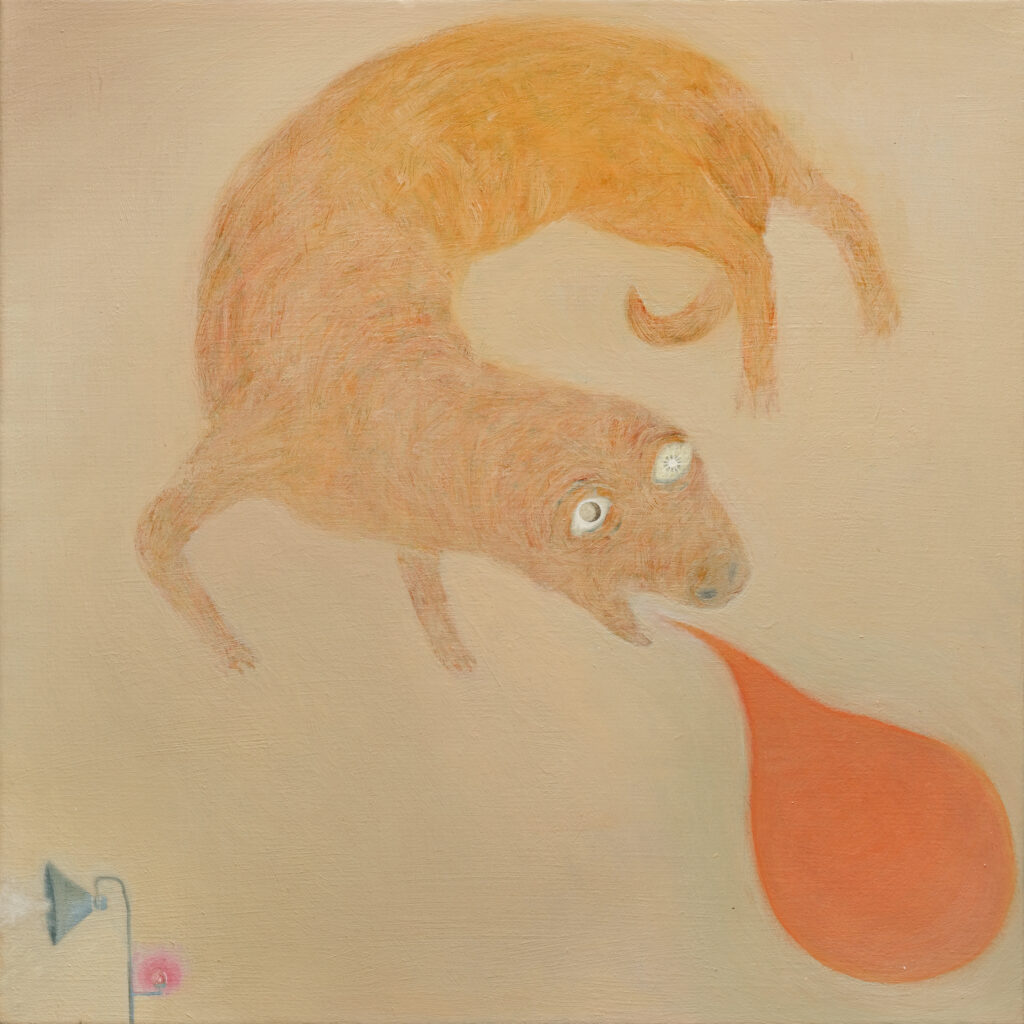
Wong-Shen: Those symbols also change depending on the period and the theme of each work. It really depends on what kind of situation I’m trying to deal with in the painting. Some symbols are indeed placed deliberately, carrying a certain meaning. But many times, I’m not entirely sure why I choose them either—it might simply be something that emerges from the subconscious. Sometimes it’s as simple as feeling that a particular shape fits well within the composition. I might see something in real life that I want to paint, then think about how it can be arranged within the image, making adjustments and choices to see whether it can help the whole composition come together.
I have definitely been influenced by traditional Chinese opera. That kind of Chinese stage metaphor has its own very distinctive character. The stage can be almost empty—just a table and a chair—and yet it can represent a mountain or a city wall. The audience doesn’t actually need to see a mountain. As long as the actor stands on the table and performs with gestures, singing, and spoken lines, everyone naturally understands that it represents the top of a mountain. It’s very minimal, focusing only on the essential elements, while the rest is completed through the performer’s expression and the audience’s imagination.
There’s also something very unique about the sensibility of Chinese literati culture, which feels quite different from the Western approach. A few persimmons, a bare branch, or a single flower can already evoke a season or a certain atmosphere. It’s a way of achieving more with less, leaving space for people to imagine. So the streetlights and balloons in my paintings, sometimes combined with large areas of empty space, probably follow a similar logic. I don’t necessarily need to explain everything very clearly. People can make their own associations and feel something in their own way.
2. From your early abstract hard-edge color fields, to the anthropomorphic political animals that seemed to carry a sense of gunpowder, and later the Acrobatic Zoo, the dogs in your paintings have continually changed form. In terms of surface texture, the natural cracking of transparent pigments resembles the shifting conditions of the environment. The worlds depicted in your works are often interpreted as microcosms of society.
Do you hope that through these subjects you are presenting observations on society, the environment, or culture? Looking ahead, are there particular themes or issues you would like to further explore or express? During the creative process, how do you choose the symbols, subjects, and details that appear in your work so that they can simultaneously reflect social observation and personal emotion?
Wong-Shen: I’d say it’s probably all of the above. This is a multiple-choice question.
Each period is different. Sometimes, when I feel particularly sensitive about politics or have strong thoughts about it, those elements become more emphasized in the paintings. At other times, when I feel tired of politics or want to avoid it, I simply don’t want to deal with it at all. It really depends on the atmosphere of the time and my own state of mind.
The living environments and landscapes that appear in the paintings are often connected to my daily life and surroundings. I tend to place the environments I actually encounter and feel influenced by into the image first, and then layer in some of the ideas or thoughts I want to express.
As for what I want to explore in the future, it’s still hard to say clearly. I think I just have to keep moving forward and continue painting to find out. If I had to mention something new, in the past few years I’ve painted quite a few wind turbines. You can see them offshore around Taichung and Changhua—they’re a new kind of landscape. This new form of energy might be part of our future, and it’s beginning to appear in everyday life. I may continue making works related to this and see how it develops.
For now, though, it’s still difficult to say exactly where it will go. I’ll just keep moving forward and see what happens.
3. Across different periods of your practice, the degree of “negative space” in your paintings has noticeably changed. The number of dogs has gradually decreased, and the images have become increasingly simplified and direct. Do you see this shift as stemming from your observations of the social environment, or from changes in your own state of mind?
When it comes to negative space, texture, or the arrangement of details, do you deliberately keep certain elements while removing others, or does the process unfold more naturally? How does this minimalist approach affect the narrative, emotional tone, or the viewer’s experience of the work? And how do you balance simplicity with expressive power?
Wong-Shen: It’s not really about reducing or increasing them—it depends on what I want to express in the painting. Sometimes it’s just a single one; sometimes there might be many.
4. After the period of martial law, political sentiment was intense; by the presidential election it had become more subdued, and later the political elements in your work gradually diminished. You seem to have shifted toward a calmer, more passive concern for the land. You once mentioned experiencing and witnessing “the truth” firsthand. Were there any events or moments during these on-site experiences that left a particularly strong impression and influenced your work?
When confronting real political, social, or natural environments, how do you transform what you observe on site into symbols, scenes, or emotional expressions in your work? And what does this commitment to reality mean for your personal artistic pursuit?
Wong-Shen: I go to the site to see for myself, to understand what the situation is really like. That way, I can form my own judgment rather than relying on what’s reported. Nowadays, everyone has a voice, and sometimes it can feel overwhelming, like a lot of noise without real understanding.
In the past, there were many street events, and I would go to see what was actually happening. After watching for a while, I realized that many things were made to seem bigger or more serious than they really were—it was often just an atmosphere that had been orchestrated. Some people lead the chants, and many others follow without truly understanding, almost like playing a very large game. Over time, I gradually saw that there was too much manipulation in politics and society. I couldn’t watch it anymore, so I returned to painting my own work.