


INTERVIEW: That’ll Hold
[ Exclusive Interview ] ARTIST: Jan Vallverdú
1. Your work frequently features extremely sharp lines and even perfect arcs, which create a fascinating contrast with the loose, expressive blocks of color—one feels so calculated and restrained, while the other is free and expressive. With these ‘precise lines’ and ‘expressive color fields’ occupying the same space, do you want the audience to feel a sense of clash and confrontation, or rather a strange kind of harmony?
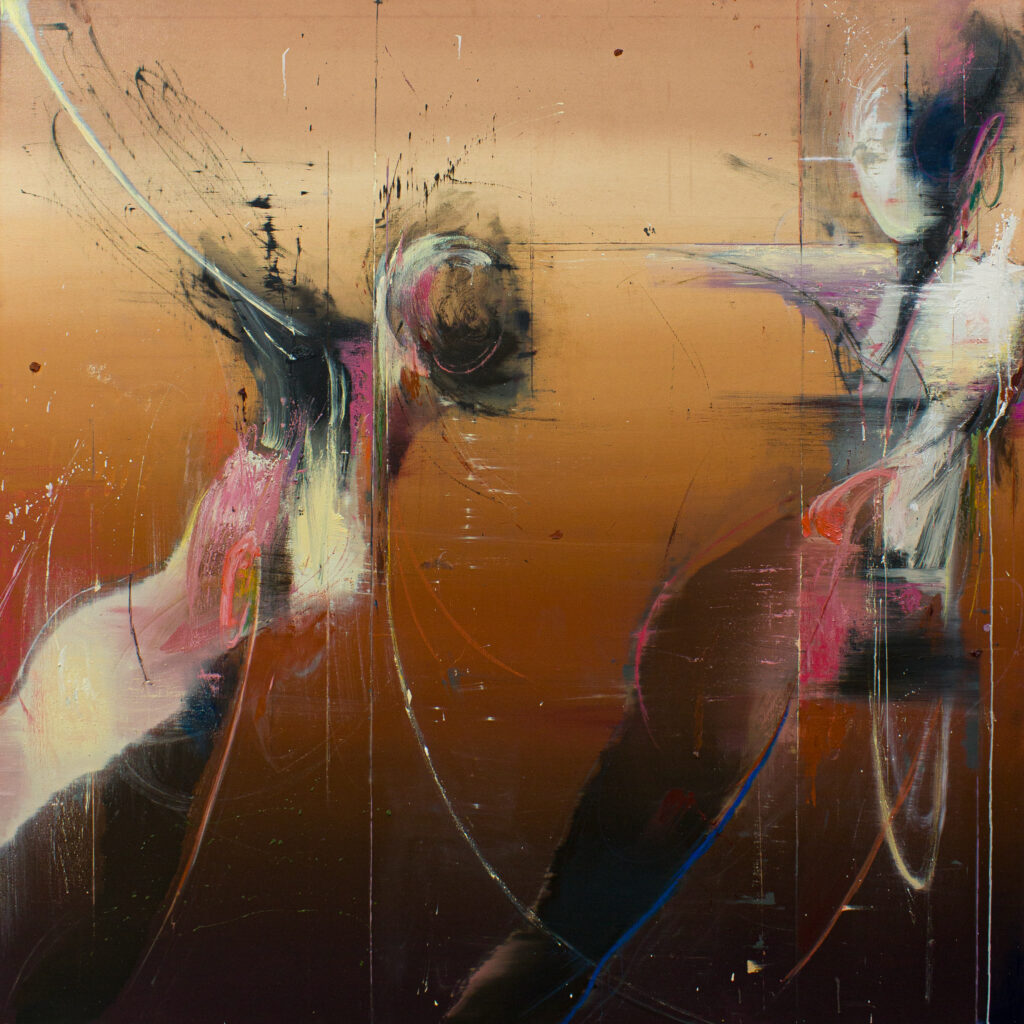
Jan: In my work, clear lines and a kind of almost wild geometry function as a structure — an architectural skeleton on which I can build organic masses and expressive disruptions within the painting.
I am interested in placing the stability of that structure under tension through a form of sabotage: an explosion or intervention that breaks it apart without completely destroying it, leaving it in a temporary, almost magical state of balance. It is a kind of stability within instability, a point of resistance. I want the painting to reach a point where the tension is at its highest, but where it can still hold together without collapsing.
That is why I am interested in confronting the aggressiveness of gesture and colour with the calmness of clean lines, quieter backgrounds and more controlled colour fields. I am not looking for a completely peaceful harmony, but rather for a tense equilibrium in which the different elements contradict one another while also depending on each other.
Sometimes I introduce obstacles into the painting, almost like putting a stick in its wheels, in order to push it towards extremes and tensions that I had not anticipated. In that sense, the process is also about escaping preconceived ideas and allowing the painting to develop its own logic beyond my initial intention.
2. I deeply appreciate the notion that ‘a vertical axis functions as a structure of containment, while color operates as force.’ Your palette selection is remarkable—some display vivid color friction, whereas others strike a harmonious resonance. Do you make these choices intuitively in the flow of creation, or do you deliberate on the intended strength of that force prior to picking your palette?
Jan: Colour is a fundamental part of my work because I am interested in using it to create atmospheres. For many years I have collected references from fashion photography, landscapes and other images that produce a particular feeling in me. I often use these references as starting points for a painting.
Sometimes I try to remain within a clearly defined palette. At other times, I use the palette only as a point of departure and gradually introduce new contrasts and colour relationships until a different atmosphere begins to appear. Although I am intuitively drawn towards visual contrast, I also impose certain restrictions on myself, working with softer or more harmonious colour ranges so that I do not always rely on chromatic aggression.
In those cases, I try to move the tension mainly into the gesture and the structure, allowing the colour to remain in a more balanced state. It is a way of exploring how a painting can function once it leaves the studio and takes on a second life in another space. Not all of its force has to come from friction between colours; sometimes it can emerge from the way a gesture cuts through a calmer atmosphere.
At times, the colours suggest the possibility of a landscape without actually describing a specific place. I am interested in creating liminal, undefined spaces that are difficult to locate, where colour functions more as a force or an atmosphere than as a direct description.
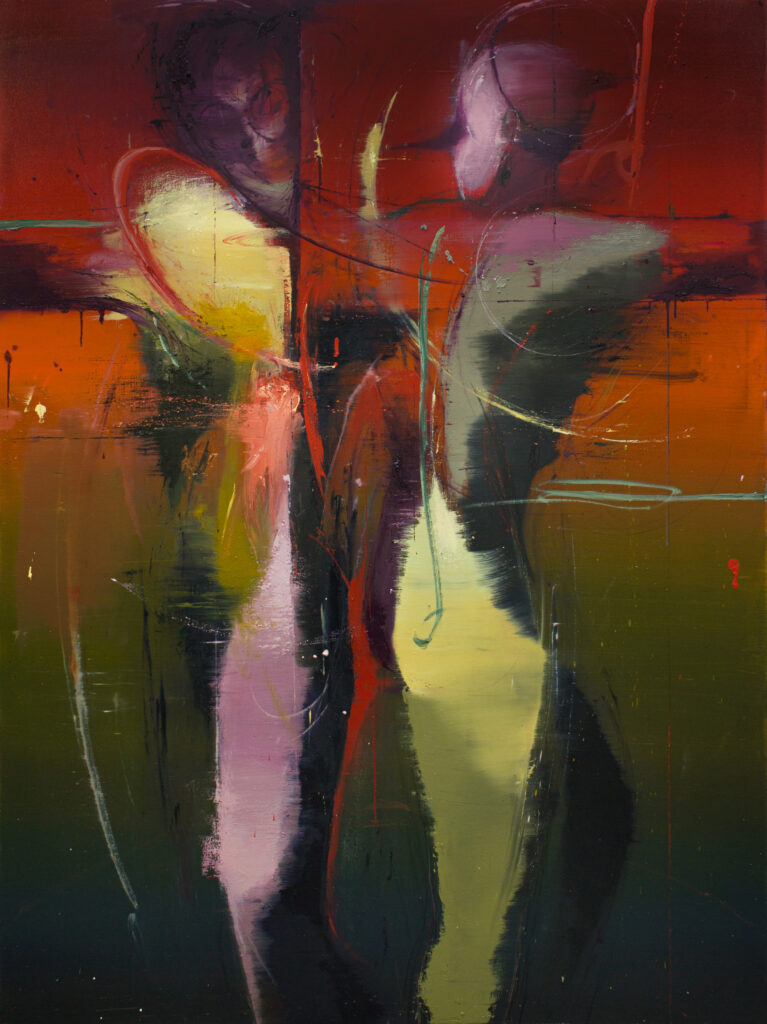
3. Looking at your paintings, I notice that the facial features of the figures are often blurred, smudged, or smeared. They seem to hover right on the boundary between human and a sci-fi, non-human entity, appearing almost elusive and spectral. Is this sense of ambiguous boundary a deliberate choice to obscure the identity of your figures, or did it naturally evolve through your creative process?
Jan: The subject of faces goes back a long way in my work. I have always been fascinated by facial expressions and by the possibility of suggesting a face with the smallest possible gesture, moving away from the academic or naïve conventions of how a face is traditionally constructed. Working through volume, smudging and sweeping marks is something that has interested me for a long time.
The face also functions as an anchor. Even when the body is highly fragmented or deconstructed, the slightest reading of a face allows the viewer to understand that they are looking at a body. It is a device I have often used to maintain a connection with something human.
Over the past year, however, I have increasingly wanted to deconstruct that anchor as well. I am interested in making the face exist on the same level as the body, the lines, the marks and the painted surface itself. In that sense, the blurring and lack of definition are deliberate choices: they suggest something without offering a closed or immediately recognisable reading.
My figures do not necessarily represent anything concrete or physical. I think of them more as voices, attitudes or forms of human and social behaviour. Sometimes they can be our other selves or our darker parts; at other times, they can feel like somebody else’s voice. That is why I am interested in keeping them within an ambiguous boundary: they retain something human, but they cannot be completely identified.
4. Your work often captures the human body in fleeting moments of motion. What do you typically observe for reference—is it the movement of dancers, the action of athletes, or simply the casual, unscripted gestures of everyday life?
Jan: I do not usually take specific movements from dancers or athletes as references. I am more interested in the casual movements of everyday life and, above all, in the tension contained within a fleeting moment: the moment of a fall, a stumble, a leap or an act of pursuit, as if the painting were capturing a single frame from a film.
Movement often functions as a metaphor for a mental state, a personal situation or a particular social tension. I am also interested in dragging, shifting, moving in a nearly subterranean way, or approaching something that cannot quite be reached.
Gesture and movement blur forms and allow one thing to become something else. Sometimes I think this confusion also has a social dimension: movement and noise can be used to obscure certain things or make them more difficult to read. However, I do not usually begin with a completely defined idea. I work intuitively, asking myself what else I can do with the painting within my own limits, and many of these meanings only become apparent afterwards, once the work has been made.
5. According to your biography, many of your ideas originate from loose sketches made at night or while traveling. These sketches function as a departure point, with the final paintings often evolving into something quite far removed from the initial studies. Given that this exhibition includes two charcoal drawings, what motivated you to bring these very ‘starting points’ into the gallery space and share them with the audience?
Jan: When I travel, I often make quick sketches to capture spontaneous ideas or images that suddenly appear. But many of my drawings also begin with visual references that I come across and that suggest different ways of approaching composition, space or the relationship between figures. I make my own versions of these references and sometimes develop several alternatives until I find something that interests me.
Later, in the studio, I dedicate more time to developing and unfolding those ideas. Sometimes I keep a more complete composition; at other times, I take only a fragment of the drawing and bring it into the painting. For me, drawing is a way of organising ideas, testing possibilities and discovering what they might become.
I have recently been using charcoal a lot because it allows me to work in an open and gestural way. Through lines, stains and sweeping marks, I can suggest a body, a skeleton or a structure without defining its contours completely. It allows me to establish a starting point without closing the image too early.
Sometimes a formal idea from the drawing remains in the painting, but I do not believe that the drawing should determine it. A drawing is a drawing and a painting is a painting: the drawing can open up possible directions, but the painting has to find its own logic during the process.
That is why I wanted to include these drawings in the exhibition: to show some of the origins and starting points of the works, and to make visible how an image can emerge from a reference, transform itself and move from one medium into another. Not as a definitive explanation of the paintings, but as a glimpse into different stages of their development.
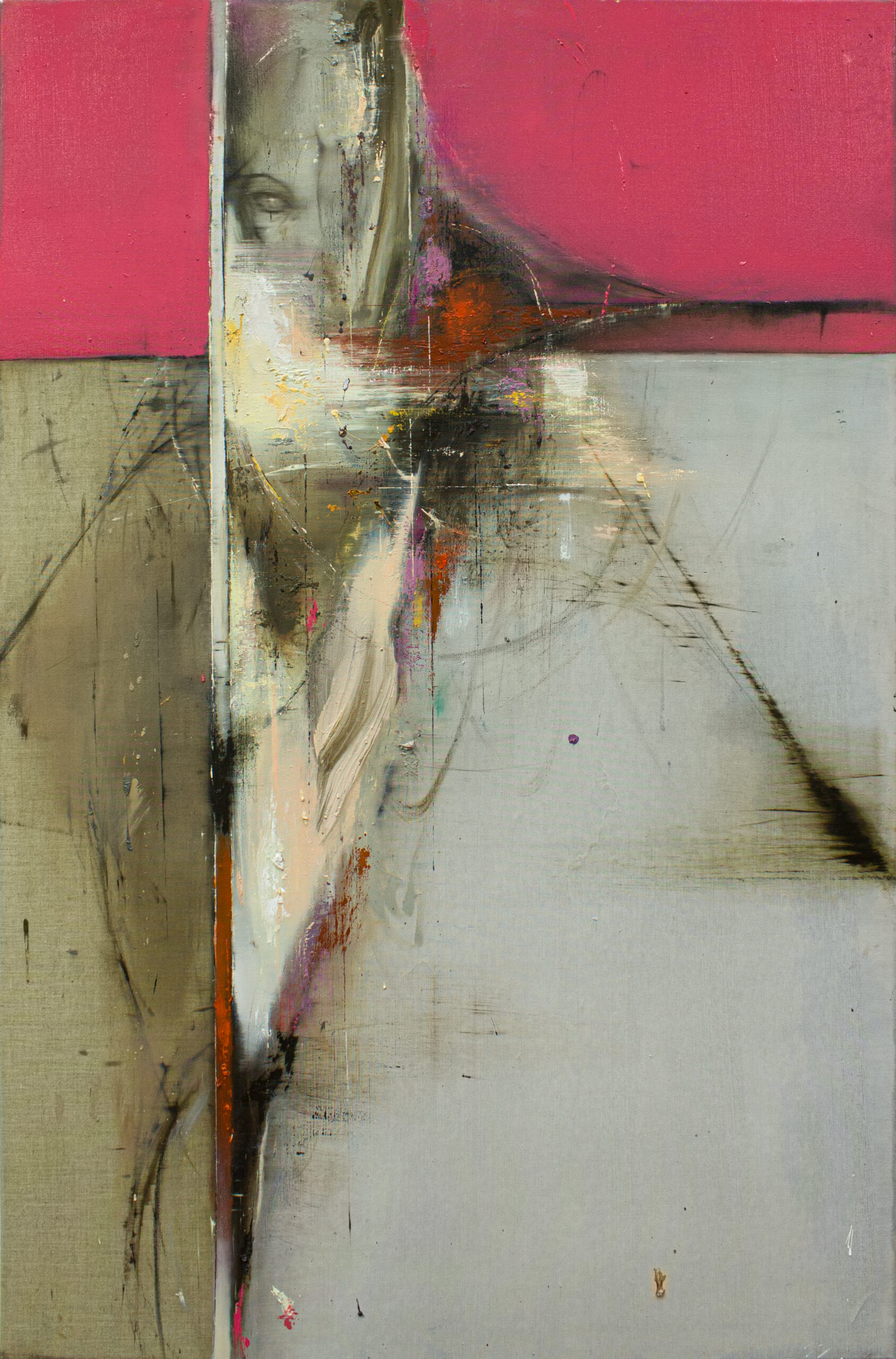
6. You started your practice using acrylics and later made the switch to oils because of the slower drying process and the ability to refine your work over time. Did this change in medium reflect a shift in how you approach the canvas, perhaps moving from quick intuition toward a more patient, ongoing conversation with the painting? Or was there another motivation behind the transition?
Jan: The transition from acrylic to oil was an important moment in my development. Drying time was one of the reasons, but I was also interested in the depth and material presence that oil could offer. I felt that it opened up a much broader horizon and allowed the work to have more weight and depth, not only in its finish but in the way it was constructed.
At that time, I was working with a great deal of material, gesture and very large formats. Acrylic had started to feel limiting because, once it dried, there was little possibility of continuing to alter the painting or keeping the process open. Oil allowed me to remain within the same state of the work for much longer — to erase, remove, add again and move through different stages before considering the painting complete.
I would not say that I simply moved from quick intuition to a patient conversation, but oil did introduce a greater degree of deliberation. The aggression and spontaneity were still present, but they no longer had to be resolved immediately. The process of putting down, removing, sweeping and rebuilding left a visible trace on the surface, and that trace eventually became an essential part of the painting.
The transition was difficult. For a while, it felt like being a fly repeatedly crashing into a closed window: continuing to insist, but not yet knowing how to move through the material. Eventually I understood that oil can be approached in many different ways, and that every artist has to find their own way of working with it. I gradually found my own method, although I still feel that I have a great deal to learn.
7. Having painted since childhood, your path eventually led to mural making and now predominantly to studio oil painting. Working on a wall versus a canvas demands a fundamentally different rhythm and physical involvement—climbing ladders and moving your entire body is vastly different from standing before a canvas today. Is there a specific experience from your mural days that still stays with you, or perhaps even influences the way you apply paint to the canvas today?
Jan: My beginnings were connected to graffiti and the street, and later to mural painting, although always from a fairly alternative perspective. We made our own tools, worked collectively and used abandoned spaces, poles and rollers to create large-scale murals. From the beginning, I was interested in experimenting with materials and adapting the way I worked to each space.
At that time, there was also a very direct relationship between what I was doing in the street and what I was developing in the studio. I worked with commercial wall paint for murals, recycled hospital sheets to paint on a large scale and constantly looked for ways to expand the physical possibilities of painting. That need to experiment and push the body and the gesture to their limits is still present in my work today.
Although I now work mainly with oil and on different formats, my painting is not a static, easel-based practice. There is a great deal of physical movement, impulse and tension in it. I move around the canvas, step into it and away from it, apply the paint with my whole body and maintain a direct relationship with the surface. In that sense, mural painting is still present, even though the context and materials have changed.
Working on murals also taught me to adapt to a space, find material solutions and avoid simply repeating what had already been done. I have always been interested in learning from what other people have developed, but in order to find my own way of doing things. That attitude of experimentation and personal challenge remains an important part of my practice.
At the same time, I am now at a different stage in my practice, much less directly connected to mural painting than before. Studio painting has developed its own language and its own sense of time. I am no longer trying to transfer the mural onto the canvas, but rather to preserve certain attitudes — physicality, experimentation, movement and adaptation to the support — within a practice that now functions more independently.
8. Barcelona is one of my personal favorite cities in Europe. Its warmth, vitality, and deep cultural roots are seamlessly woven into the everyday landscape, from Gaudí’s architecture to Miró’s playful and symbolic public art. They are truly inseparable from the very fabric of the city. I was wondering if there are specific elements in your work that were noticeably influenced by the rhythm or atmosphere of Barcelona?
Jan: Yes, Barcelona has clearly influenced my work, although I would not say that my paintings come directly from the aesthetics of Gaudí or Miró. Miró has probably been more present for me, but Barcelona’s influence has more to do with its atmosphere, its rhythm and its cosmopolitan character.
During my earlier years, especially when I was more closely connected to mural painting, Barcelona was a very active city for urban art and was also strongly connected to international trends in design and visual culture. Growing and working within that context made me attentive to what was happening around me and to new ways of working. The Mediterranean character of the city also marked me, and I see it as one of the main differences between Barcelona and other places.
For me, however, Barcelona is not only the city itself, but also its periphery — Hospitalet and the surrounding areas, where I have lived and worked. I shared industrial spaces, studios and self-organised projects with other artists and friends. Many of those relationships were fundamental to building my career and finding my place within the art world.
Perhaps none of this appears literally in a finished painting, but it is present in the process that has led me to the work I am making now. The need to work independently, experiment, collaborate and find solutions with limited resources has created a certain attitude of resistance and resilience that is still part of my practice. Barcelona and its periphery have been my habitat, and that habitat has inevitably influenced both my work and the way I understand myself as an artist.
9. The text for this exhibition offers a great deal of thought-provoking reflection. I was wondering if there are any books you have read recently, or movies and series you have watched, that particularly inspired you or even influenced the direction of your work?
Jan: Sincerely, there is no recent book, film or television series that has directly influenced this exhibition. I do have cinematic and literary references that have contributed to shaping the way I perceive images, bodies and atmospheres, but I would not draw a direct connection between a specific work and That’ll Hold.
In this case, the most immediate influence during the painting process has been music. Music accompanies a large part of my studio sessions, especially electronic music and different forms of techno. It does not function as a specific visual or narrative reference, but it does influence the rhythm, concentration and energy with which I work.
Rather than beginning with something I have recently read or watched, my painting emerges from what I perceive: atmospheres, gestures, tensions and states that accumulate over time and later appear transformed within the work.
10. From the Inhibición project in Denmark back in 2018 to your residency at Danny First in Los Angeles in 2025, you have taken part in artist residencies across several different cities over the years. Is there one particular residency that left the deepest impression on your work or life? Could you share that experience with us?
Jan: To be honest, I would have liked to take part in more residencies. At this stage of my career, and also in the years before, I have always found them to be very positive experiences because they offer something that is not always easy to find: time, space and concentration to work without too many distractions.
The El Núcleo residency in Segovia was especially important to me because it took place just before my transition from acrylic to oil. I was able to concentrate on my work for an extended period, close one stage of my practice with acrylic and work within a kind of self-imposed retreat or creative immersion. It was also significant because it marked my first entry into certain gallery circles in Madrid and opened up new opportunities for me.
However, my residency with Danny First in Los Angeles in 2025 is probably the one that has left the most recent and deepest mark on my life. It was a residency I had been imagining for a long time and had always seen as something very distant. Being able to travel to Los Angeles, experience a completely new city and engage with its museums, galleries and artists greatly expanded my perspective. It allowed me to understand that there were other markets, other rhythms and other ways of relating to art.
It was also important because of the visibility it brought me. The possibility of working with Artemin Gallery emerged from that residency, which is a good example of how these programmes can open up unexpected possibilities. I do not think a residency should be approached solely as a way of advancing your career, but encounters and opportunities that you could never have anticipated can emerge from it.
For me, that is one of the most important values of residencies: as well as providing a space for production, they allow you to leave your usual context, encounter different environments and discover new possibilities within your practice. Although the application process can be long and demanding, residencies remain a very valuable part of the wider art world.
11. Your biography notes that each of your series evolves naturally from the one before it. In the case of That’ll Hold, what do you see as the most noticeable shift or progression compared to your previous body of work?
Jan: I think the evolution of each series also depends on how long I feel it can remain alive. For me, it is important not to settle into a formula and to continue questioning my own work. I am interested in putting my own decisions into doubt, moving beyond certain comfort zones and avoiding the temptation to rely on effect for its own sake or to accept too easily whatever is already working. That questioning is what keeps me motivated and allows me to move forward.
In the case of That’ll Hold, the series continues the line of work I began developing after my residency with Danny First and on which I have been concentrating over the past year. If I compare these works with those closest to that period, made around a year ago, the most noticeable evolution can be found in the way I approach the figure.
I am interested in moving away from the face functioning as such an obvious visual anchor. Although it is still present, I no longer want it to make the body immediately legible. I also feel that the gestures are now looser and more natural, perhaps less aggressive. There is more restraint in the sweeping marks and in the way the paint is applied, while solid colour fields and gradients occupy more space and carry greater weight within the composition.
The exhibition brings together works made throughout this process, between 2025 and 2026, so there are also differences from one piece to another. I do not see this as an abrupt change, but rather as a gradual evolution within the same line of enquiry: continuing to question what came before, shifting the painting’s points of support and looking for new ways to sustain its tension.