


INTERVIEW: One and One
[ Exclusive Interview ] ARTIST: Nicolas Mehdi Pour Vahid
1. You mentioned in a previous interview that Hayao Miyazaki’s My Neighbor Totoro was the first major aesthetic shock for you as a child, and that you grew up surrounded by manga and animated films. We can also see manga-inspired outlines in your current work. How did this childhood visual experience with anime and manga gradually shape your current painting style? Would you mind sharing with us some of your favorite manga?
Nicolas: When I was little, I remember my mother bringing home a wheelbarrow full of comic books from the library every week. I grew up with the drawings of Akira Toriyama in Dragon Ball, Hayao Miyazaki, and Katsuhiro Ōtomo (Akira). I drew a lot, and what I loved about these artists was the simplicity and detail with which they managed to convey emotions—not just through expressions, but also through gestures and postures. I believe I still have a deep attachment to drawing, to understanding a figure, to its weight, and to the full range of emotions that its lines can convey. It’s something Miyazaki pays uncompromising attention to in every frame of his films, starting with the storyboard. Watching Totoro was, for me, first a discovery of cinema, and then of worlds in which children’s perspectives are the most perceptive—particularly regarding their environment and the other living or extraordinary beings with whom we share this space. Today, I’m a huge fan of the humor in JoJo’s Bizarre Adventure and the mythological universality of One Piece.
2. In your recent works like Yufutozanguchi and Crossing the Chassezac, the figures often seem surrounded by a faint halo of light. You once mentioned that you grew up spending a lot of time in your mother’s religious sculpture restoration studio. Is there a connection between the two? How did that upbringing influence your later creative work?
My mother’s work and the memory of her studio have had a profound influence on my own work. First, I view sculpture as the twin of drawing, since a sculpture is a series of profiles that can be captured by a line. Second, the sculptures my mother restored possessed a powerful sacred quality. Sarcophagi, Christian icons, mythological figures… All possessed a history and a soul from a time long past, and my mother’s entire work consisted of literally digging into that history to unearth its polychromatic splendor. I have always been reassured by the heroic presence of these sculptures and of their sculptors through them. I love their solitude, their imperturbable torments, and their capacity to welcome the projections of our own emotions. Perhaps I would like my figures to resemble them a little.
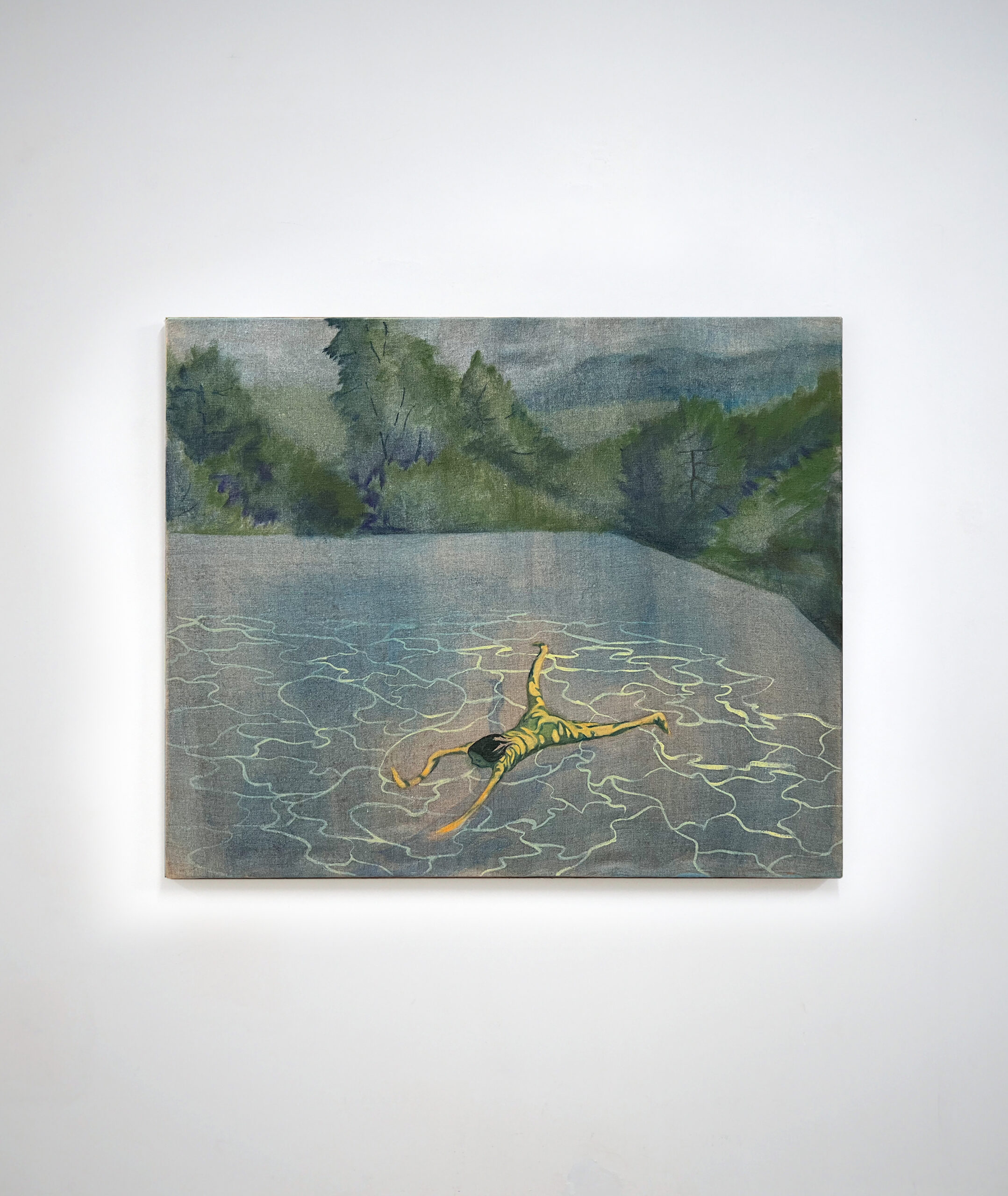
3. In the poem Silence featured in this exhibition, you wrote: “I am a comic book hero.” This line really stands out in the poem, and it reminds us of the manga you published in the past. Did you ever imagine yourself as a comic book hero when you were a child? Yet, right after that, the line “When was that? Before the waves.”, which suddenly gives the feeling of childhood fantasy being washed away. Does this passage come from a particular childhood memory?
When I was a child, I often dressed up to become my favorite heroes, like Zorro or Goku… I would involve my little brother and sister in my stories. I remember that time as one overflowing with play and imagination. Then, suddenly, my parents divorced in a remarkably violent way. I was separated from my brother and sister and thrust into adult life. I have a filmmaker friend who showed me a video from last summer before his mother passed away. We simply see him and his brother watching the waves. His older brother stares out at the open sea, impassive, and seems already far away, while the younger one clings to him like the mast of a boat, as if he sensed the tragedy and the almost inevitable distance that would follow. I felt strangely close to his older brother, with whom I shared a deep melancholy.
4. You’ve mentioned before that your work often stays in an “in-between zone”—somewhere between the initial wonder of discovering the world and the sense of loss that comes with growing up. Many of your pieces seem to capture this subtle sense of transition. What does this “in-between zone” mean to you personally?
Nicolas: I’m uncertain. Some people talk about the past, others about the future. Some rely on the past to build a future, and so on. My figures seem stuck between the two, neither in one nor the other. It’s like walking a tightrope. I think there’s a certain sense of wandering there.
5. There seems to be a very natural dialogue between your solo exhibition. One and One (淡淡) and Edward Yang’s film Yi Yi (一一). The children in your paintings, with their backs to the viewer, quietly gazing at the world, remind us of Yang-Yang in the movie. That quiet, restrained, and almost paused atmosphere feels very much like the long takes in Asian cinema. As a fan of Edward Yang, how has Asian cinema influenced your creative work?
Nicolas: Perhaps the idea of accepting the multiple and contradictory nature of a particular feeling, even if it may seem insignificant or trivial. The insignificant that becomes the infinite. I find this in Yasushi Inoue’s short stories, in which children react, without realizing it, with a prescience and acute understanding of an adult situation that is beyond them. In Yi-Yi, faced with the grandmother’s comatose silence, each character engages with their own resources in a search for their reality/truth. In Kurosawa’s Ikiru, the announcement of the main character’s impending death confronts him with the emptiness of the life he has led. This exploration of that same emptiness becomes the fertile space that allows him to find meaning. The idea that emptiness holds the potential of fullness if we allow ourselves to invest in it. There is perhaps something here of the poetics of blandness (hence the title 淡淡 ) that struck me deeply. I love the space this creates. Perhaps that is what struck me first in the films of Bì Gàn, Hou Hsiao Hsien, Apichatpong, Tsai Ming-lang, or in the books of Yukio Mishima. I would like to create similar spaces in which the viewer can lose themselves and let their own feelings circulate.
6. In The Flowers of Evil, Baudelaire once asked, “What will you say tonight, lonely soul?” Your work carries a similar lingering, quiet sense of loneliness, yet the wind, mist, and mountains in the background seem to be softly responding to these silent figures. For you, does this loneliness feel like something you experienced growing up, or is it simply your way of observing the world?
Nicolas: It’s a feeling I’ve always sought out from time to time. I believe that solitude is a necessary condition for exploring deep emotions. Solitude is also often silence. We’ve talked about the emptiness that precedes all things. It feeds melancholy. I like the idea that we can sometimes take pleasure in a vague, gentle sadness.
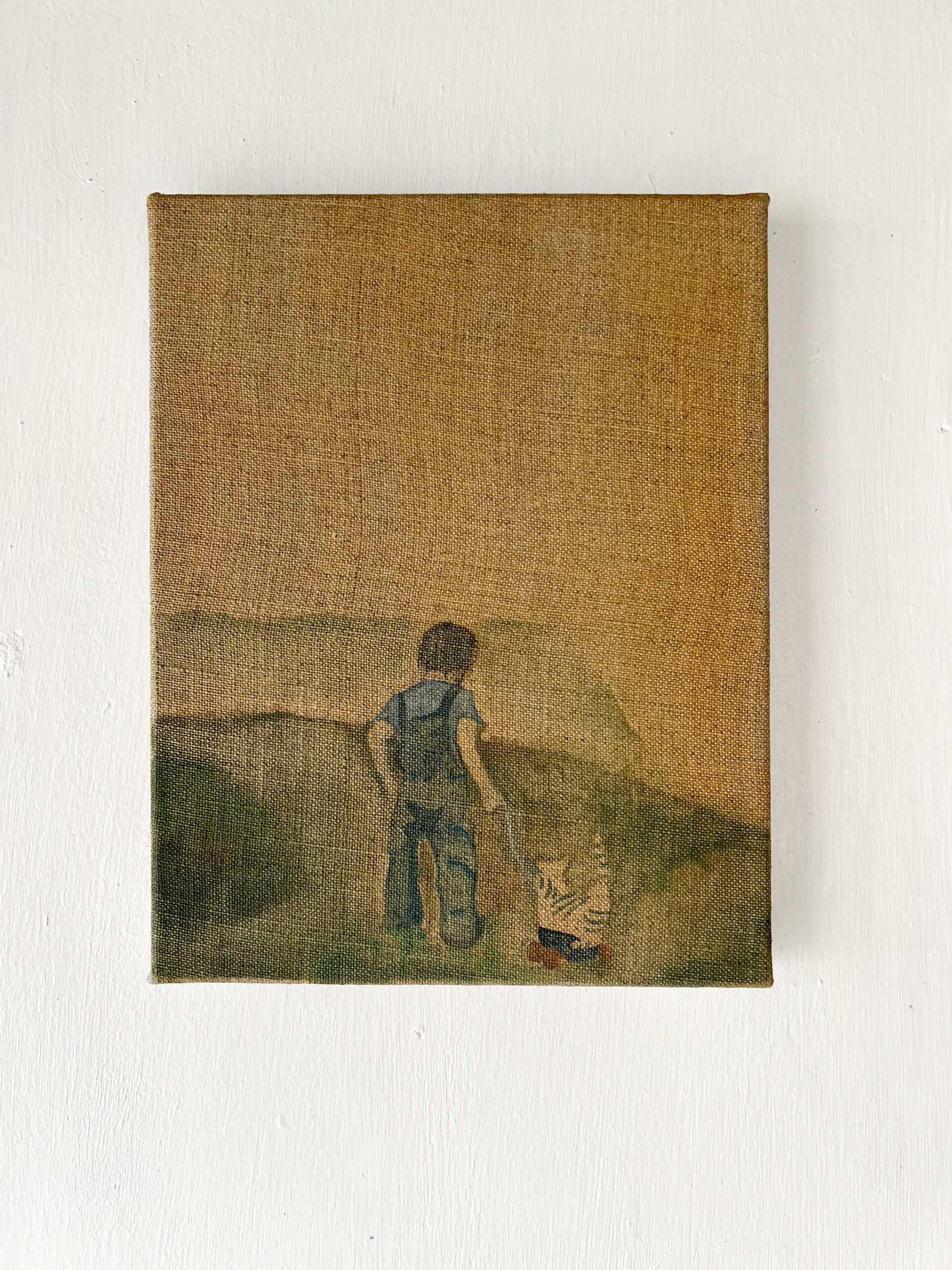
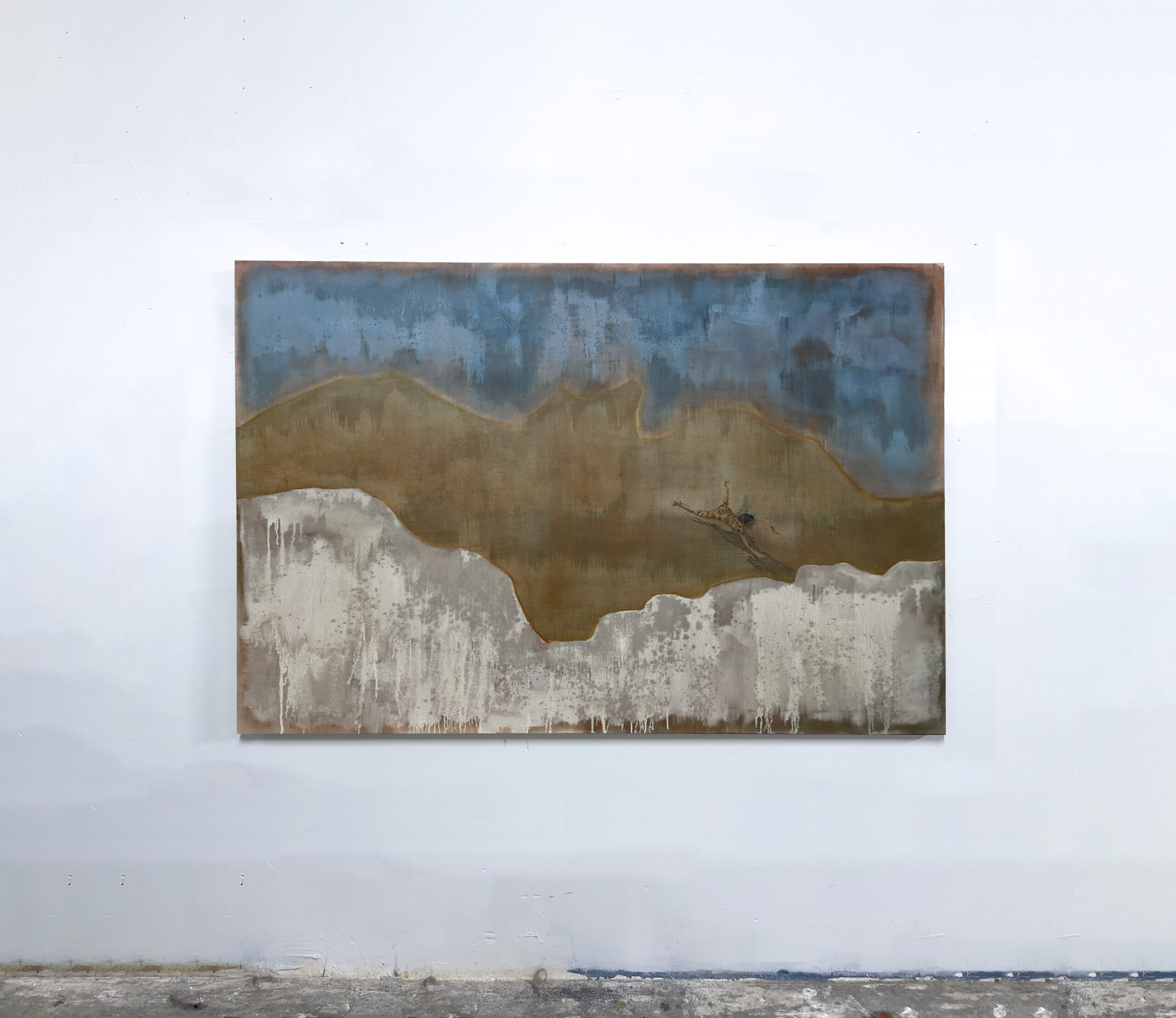
7. You often preserve the natural texture of the linen canvas, letting the paint slowly soak in like mist. The colors in your paintings always carry a fading quality. How did this particular painting technique develop? Is this blurry, dissipating texture also a part of your narrative?
Nicolas: This technique developed during my residency last year in Los Angeles at The Cabin LA. I had a month to produce five very large-format works. Of course, I had prepared numerous studies before going there, and I had my compositions in mind. Danny First, the founder of this residency, offered to provide the materials of my choice, so I turned to linen. There is a theory in traditional Chinese painting that states that the larger a painting is, the more empty space there must be. Linen was the perfect material to give a particular depth and substance to that emptiness. It was a time when I was researching the concept of aesthetic blandness. In short, all the conditions were in place for exploring the material, and since then I never tire of letting myself be surprised by its qualities and its unpredictability.
8. In the pieces you created during your residency in Kyushu, Japan, natural elements like forests, hot springs, and ocean breezes slowly immerse the canvas. Interestingly, these works feel less like a direct record of travel scenery and more like internal landscapes. How do you transform a real physical landscape into a space filled with such personal emotion?
Nicolas: I think what helps me is color and light. I refer to very specific things, like the photos I take. But when it comes to translating them into a painting, I focus on the relationship between the sensations I remember from that place and those evoked by the colors and shapes. For me, it’s like an abstraction of shapes and light, and what I choose to keep is where my memory resides. I believe this is something everyone does with their own memories—unconsciously choosing what to hold onto.
9. Beppu in Kyushu is a hot spring town with a wonderful, old-school charm, and you stayed there for two months. We’re very curious—what was your daily life like back then? Did you go to the hot springs often like the locals? What did you find most unforgettable about that slow-paced town?
It was my first time in Japan, a country I’d long fantasized about through my artistic influences. And in fact, when I went there, I wanted to live as ordinary a life as possible for two months. It was very important to me to establish a real routine—almost ritualistic—to try to grasp the spirit of the city and its people, beyond the exoticized fantasy. I worked in the mornings, impatiently waiting for the little canteen run by an elderly woman to open. By 11:45 a.m., the neighborhood workers would gather there. Then I’d go buy some treats at the famous bakery on the street to bring to the hairdresser who had cut my hair on the first day. She would offer me coffee, and I would listen to her talk, full of laughter and vivid expressions. Then I would go buy a mochi ice cream and eat it by the sea, where Mount Takasaki plunged into the water—a sight that leaves me with an omnipresent memory of a benevolent presence. I would go there to watch the sky turn madder red at the end of the day, filled with a gentle melancholy. Once the sun had set, I would go to the same neighborhood public bathhouse, used by the locals, for which I even had a membership card. There was no bathroom in the residence. I did this absolutely every day except for the days I spent in the mountains taking photos and notes. Everything was ritualistic: the hellos, the thank-yous, the goodbyes, the music in the stores, the smells.